


Washington- The Republicans on the Budget Committee United States House of Representatives approved this Thursday a $95 billion package aimed at war with Iranagricultural aid and the president’s initiative donald trump to impose strict new voter identification requirements, and they managed to push the measure forward with a vote that followed the party line despite the difficulties encountered on the floor of the House of Representatives and in the Senate.
Budget Committee Chairman Jodey Arrington presented the proposal as a last-ditch effort to meet voters’ expectations ahead of the midterm elections, which will determine who will control Congress. The proposal was approved by 20 votes in favor and 14 against.
“We are moving to finish what we started when the American people sent us here,” said Arrington, R-Texas.
With funding for the war in Iran making up the bulk of the package, about $60 billion, Arrington acknowledged that “why we are there” in the conflict abroad can be debated. However, he said the money is needed for basic supplies: “just the bombs, the bullets and the battlefield preparation so that our uniformed men and women can finish the fight successfully and come home safely – that’s all.”
The resolution, which establishes instructions for the various congressional committees to prepare proposals, also provides $13 billion for Intelligence, $12 billion for Agriculture and $10 billion for Administration, which is responsible for voting and elections.
Speaker of the House acts on his own
The proposal is the third package of budget reconciliation measures that Republicans, who control Congress, have presented this session to impose Trump’s priorities over the objections of Democrats, using a legislative procedure that allows their approval by a simple majority.
It’s the same process that House Speaker Mike Johnson used to pass Trump’s big tax cuts bill last year and to allocate funds to the Department of Homeland Security (DHS) after Democrats refused to fund the department following the deaths of several Americans protesting against the actions of the Immigration and Customs Enforcement (ICE, in English) earlier this year.
Johnson is promoting this initiative practically alone, without having the full support of either his slim Republican majority in the House of Representatives or the Senate. This week he had long meetings with Trump in the White House and organized a private session for Republicans at the Camp David presidential residence to finalize the details.
However, the 47-page package remains an initiative with little chance of success – too little for some, too expensive for others – ahead of the vote in the plenary session of the Chamber of Deputies scheduled for next week.
Prominent Republican Representative Chip Roy, an influential member of the Freedom Caucus who has expressed reservations about the package, did not vote in the Budget Committee session as his home state of Texas faces flooding.
A “failed presidency”
Democrats are prepared to vote against the proposal, as they did on Thursday during the committee session.
Rep. Brendan Boyle of Pennsylvania, the top Democratic representative on the Budget Committee, said the document, about 6,500 words, does not mention at any point the issue that most concerns many Americans: affordability.
“People know this is a failed presidency and a failed Republican majority.”Boyle said.
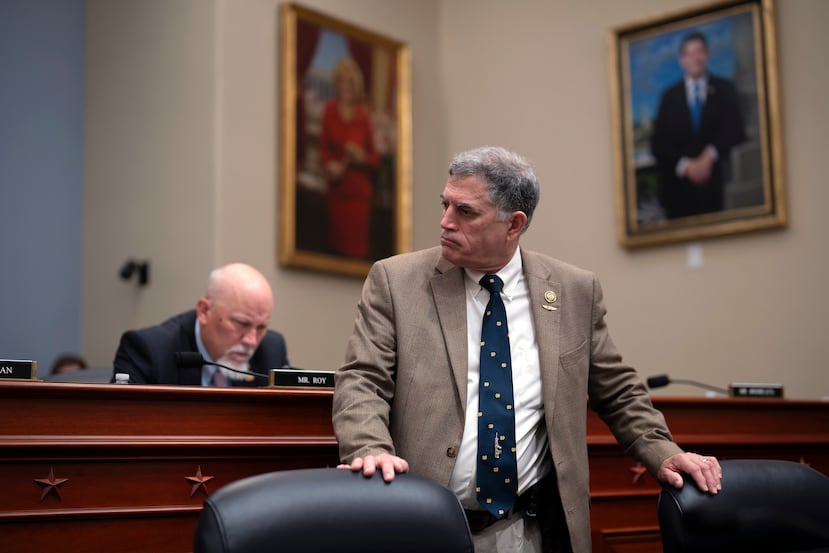
Democrats introduced more than a dozen amendments to the package during the hours-long Budget Committee session, raising questions about how the new spending will ultimately be financed: either through budget cuts in other programs or by increasing the public debt.
Boyle introduced an amendment to reverse health care cuts in Republicans’ big tax cuts bill. Rep. Ilhan Omar, D-Minn., sought to restore food stamp funding under the Supplemental Nutrition Assistance Program (SNAP, in English). Rep. Scott Peters, D-Calif., suggested that funding for immigration enforcement at DHS could be used to offset costs elsewhere.
Rep. Lloyd Doggett, D-Texas, blamed the high cost of living on the war in Iran and said that every time Americans open the refrigerator or fill up at the gas station they are “paying for a war that should never have started.”
Senate rejects House plan
The next steps appear very uncertain, since the Chamber of Deputies holds an exceptional pro forma session on a Saturday, a meeting of mainly administrative nature that will allow the resolution to be presented in time for processing next week.
Johnson can only afford to lose a few detractors from his own party, since he depends exclusively on Republicans to pass the law, without the support of Democrats.
However, The resolution would also have to be approved by the Senate, and Republican senators have harshly criticized the House initiative, waiting to see if Johnson can get it passed.
Senate Majority Leader John Thune said senators have “many questions” about it, from advocates of a more aggressive defense policy, concerned about the military, to those who advocate a deficit reduction policy and want to offset the costs.
“It’s a very bumpy road,” he said. “We will see what the Chamber of Deputies can carry out,” he added, but “for my part, I cannot give any guarantees.”
Sen. Ron Johnson, R-Wis., who is expected to take over as chairman of the Senate Budget Committee following the sudden death of Sen. Lindsey Graham, has been a leading advocate of budget austerity, concerned about the country’s rising deficit.
The Chamber of Deputies plans to have its committees work on the text of the bill during the August recess and for the full package to be voted on again in plenary in the fall.

