

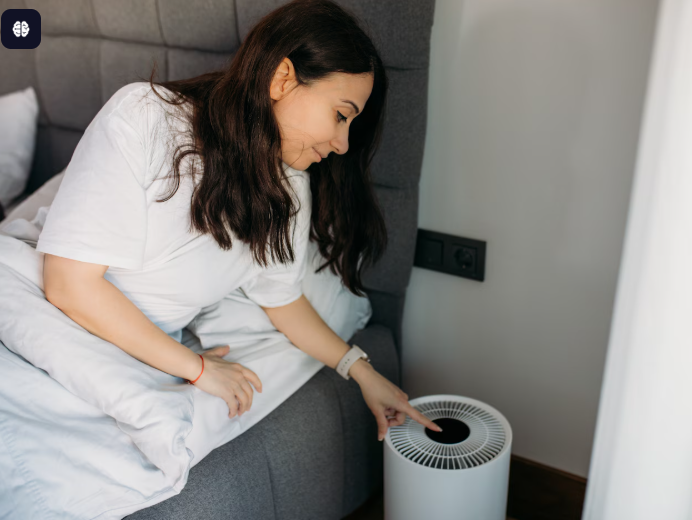
In preliminary research, people with prediabetes who used a HEPA air purifier overnight for a month experienced modest improvements in blood sugar stability.
“There’s a lot of research linking pollution with worse blood sugar outcomes, including the development and progression of diabetes,” said Sharine L. Wittkopp, lead author of the study who is a cardiologist at NYU Langone and clinical instructor at NYU Grossman School of Medicine. “We wanted to see if we could flip that; if decreasing the exposure could lessen the risk.”
What we know about air quality and blood sugar
A growing body of research suggests the harms of air pollution include greater risk of poor metabolic health and Type 2 diabetes.
When it comes to why, we still have “more questions than answers,” Petersen said. One explanation is that the particles you inhale may seep into your bloodstream and damage the lining of your blood vessels, he explained, which insulin needs to pass through to effectively manage blood sugar levels. In turn, this can interrupt insulin signaling, or how well insulin tells the cells in your muscles to soak up sugar from your blood, resulting in an excess and raising your risk of diabetes.
Depending on the specific particles and how they affect the blood vessel walls, insulin resistance can happen very quickly, said Sanjay Rajagopalan, chief of cardiovascular medicine at University Hospitals Harrington Heart & Vascular Institute. This could be why even a small intervention, such as cleaning the air in a room of your home, “could have a positive effect on metabolic health,” he said. (Rajagopalan was not involved in the study.)
In the new study, 150 adults with prediabetes (based on A1C levels) were randomly divided into two groups. Seventy-six of them received a portable air cleaner with a high-efficiency particulate air (HEPA) filter — a device that clears microscopic particles such as PM2.5 from indoor air — and 74 of them got a sham device. (Anyone on medication for diabetes or with evidence of plaque buildup in their arteries was excluded, as was anyone who smoked in their home or lived with someone who did.)
All participants wore a continuous glucose monitor (CGM) to track their blood sugar for one week before using their designated device, then set up their device in their bedroom and ran it continuously for five weeks. During the final week, they wore a CGM once more, so the researchers could see how their blood-sugar numbers shifted from the initial readings.
Those who used the real air cleaners — which cut levels of PM2.5 in the air by 36 percent — showed an 8 percent drop in daily blood sugar swings, meaning their blood sugar stayed in a narrower range, Wittkopp explained.
A reduction in blood sugar variability has been tied to lower risk of heart disease and mortality in people with Type 2 diabetes. Whether it could improve health in people with prediabetes is less clear, Petersen noted.
These shifts are roughly “equivalent to cutting out about seven grams of carbohydrates from a meal,” Wittkopp said, based on prior studies tracking blood sugar changes alongside meal consumption. That equals removing two teaspoons of sugar from breakfast, she said, or about the amount in a small doughnut. It may not be a huge benefit, but it’s one that could compound with time, Wittkopp said.
What to consider before trying this at home
There are a few limitations to the new study, namely that it was conducted over a relatively short time period in a small group of people. It doesn’t prove that air filtration explicitly caused the noted improvements in blood-sugar control, only that the two are linked. It’s possible, for example, that people in the active-filter group might’ve also eaten a healthier diet, and this could’ve contributed to the effects, Petersen noted, though randomization makes this less likely.
At the same time, an in-home air purifier can only go so far to reduce your exposure to PM2.5, Rajagopalan said. A broader reduction requires industry- and society-level change to limit sources of pollution.
That said, there’s no downside to using a HEPA air cleaner, if you can afford the price. Smaller ones, meant to clean the air in a smaller space, cost around $80, while larger devices can run upward of $800, with most falling in the $100 to $200 range. (The label will tell you the largest size room that it’s effective in.) You’ll also need to replace the HEPA filter every six to 12 months (these typically cost between $20 and $80); the energy costs of running an air purifier are minimal.
The American Heart Association suggests that those at elevated risk of heart disease, including people with diabetes, consider “personal interventions” to lessen exposure to pollution (such as using a portable air cleaner indoors) when local air quality is poor.
Some of the benefits of in-home air filtration may still be theoretical or hypothetical, Wittkopp said, but “we already know there is no healthy amount of air pollution to breathe in.”

