

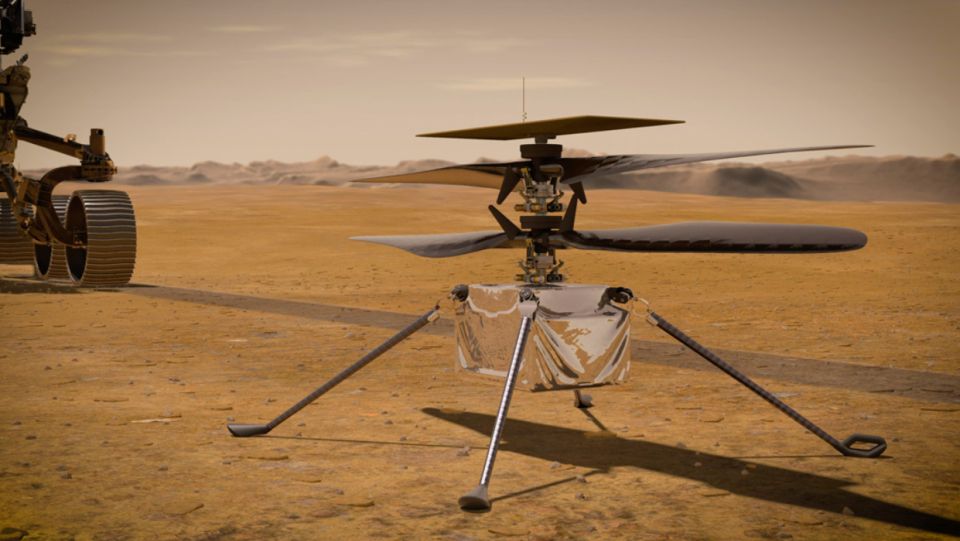
Here are 6 facts about the helicopter built by NASA to fly over Mars.
The first helicopter that will attempt to fly on another planet is an engineering marvel. It successfully arrived Thursday on Mars, carried by the Perseverance rover, and is part of the equipment NASA has designed to explore the Red Planet.
NASA’s Ingenuity Mars Helicopter may weigh only about 4 pounds (1.8 kilograms), but it has mammoth ambitions.
Here are six key facts about the first helicopter to go to another planet:
1. Ingenuity is a flight test 2.
The Ingenuity helicopter is what is known as a technology demonstrator: it has four specially made carbon fiber blades arranged on two rotors that spin in opposite directions at about 2,400 rpm, many times faster than a passenger helicopter on Earth. It also has innovative solar cells, batteries and other components, carries no scientific instruments and is a separate experiment from the Perseverance Mars 2020 rover.
Ingenuity will be the first spacecraft to attempt controlled flight on another planet.
What makes it difficult for a helicopter to fly on Mars? For one thing, Mars’ thin atmosphere makes lift difficult. Because Mars’ atmosphere is 99% less dense than Earth’s, Ingenuity has to be lightweight, with rotor blades that are much larger and spin much faster than would be required for a helicopter of Ingenuity’s mass on Earth.
It may also be bone-chillingly cold at Jezero Crater, where Perseverance landed with Ingenuity attached on Feb. 18, 2021. Nights there drop to minus 130 degrees Fahrenheit (minus 90 degrees Celsius). The cold will push the design limits of many of Ingenuity’s parts.
In addition, JPL’s remote flight controllers will not be able to control the helicopter with a joystick. Communication delays are an inherent part of working with spacecraft at interplanetary distances. Commands will have to be sent well in advance, and engineering data will return from the spacecraft long after each flight takes place. In the meantime, Ingenuity will have a lot of autonomy to make its own decisions about how to fly on point and maintain itself.
3. Ingenuity is an appropriate name for a robot that is the result of extreme creativity.
High school student Vaneeza Rupani of Northport, Alabama, originally submitted the name Ingenuity for the Mars 2020 rover, before it was called Perseverance, but NASA officials recognized the submission as an excellent name for the helicopter, given the creative thinking the team employed to get the mission off the ground.
In February 2021, NASA’s Perseverance Mars 2020 rover and NASA’s Ingenuity Mars Helicopter (shown in an artist’s concept) will be the agency’s two newest Mars rovers.
Both were named by students as part of an essay contest.
4. Ingenuity has already demonstrated engineering prowess.
In careful steps from 2014 to 2019, JPL engineers demonstrated that it was possible to build an aircraft that was lightweight, capable of generating sufficient lift in the thin atmosphere of Mars, and capable of surviving in a Mars-like environment. They tested progressively more advanced models in special space simulators at JPL. Failure at any of these milestones would have scuttled the experiment.
5. Ingenuity team will count success step by step
The team has a long list of milestones to overcome before the helicopter can take off and land in the spring of 2021. The team will celebrate each time one is achieved. The milestones include:
Surviving the launch from Cape Canaveral, the cruise to Mars and landing on the Red Planet. And they’ve already achieved it
Deploying safely to the surface from the belly of Perseverance.
Maintain warmth autonomously during intensely cold Martian nights
Charge autonomously with its solar panel
Ingenuity will make its first flight attempt. If the helicopter is successful on that first flight, the Ingenuity team will attempt up to four more test flights within a 30-day Martian window (31 Earth days).
6. If Ingenuity is successful, future Mars exploration will include its aerial view.
The helicopter must demonstrate the technologies needed to fly in the Martian atmosphere. If successful, this could enable other advanced robotic flying vehicles on future robotic and human missions to Mars, with an aerial view, high-definition imaging and reconnaissance, and allow access to terrain that is difficult for rovers to reach.
With information from NASA

