


The art of bonsai transformed the lives of Luis Collazo Jimenez and his wife Nilda Rivera, who learned the secrets of this discipline that originated in China nearly two millennia ago.
The couple from Aibonite entered this fascinating world at the end of the 90s. and, since then, he has dedicated himself to sharing his experience with the cultivation of trees in trays whose dimensions are controlled using techniques that prevent their growth.
According to Don Luis, owner of Collazo Plants, “we have always worked in agriculture, with plants and birds.”
“I was a bird seller, selling small chicks from an incubator in Aibonito. Then, at one point I was out of work and applied for a job at a garden where they gave me the opportunity to work as a salesman throughout the island,” recalled the 73-year-old man.
“From then on, I continued to get excited about selling plants and little by little I created my own little garden and thank God, we are a little bigger, even though it is a family business. We work here with one of our daughters,” said the father of three children.
Although their original planting consisted of poinsettias and palms, among other varieties, these flower growers dared to evolve their business and decided to take classes on the art of bonsai in San Juan, after a client “made bonsais from merchandise that we sold him.”
“That was 25 years ago. So, we kept practicing little by little and watching classes on YouTube.”
Among the plants that are turned into bonsai, according to Don Luis, are “native plants such as the flamboyant and the hucar.”
“We also work with the ucarillo, which is native to the Bahamas. In addition, we have the Chinese elm here, which we prepare ourselves because it cannot be brought from there, and other plants such as ficus and trinitaria. We can work with any small plant,” he said.
Explaining the process during the massive Flower Festival in Aibonito, Collazo, originally from the Pasto neighborhood, insisted that “Any plant can be worked, it is a question of pruning and the container it is placed in.”
“The word bonsai means plant in a tray; it is not in a pot, but in a tray. There it requires more care than any other plant because the space is small and you have to give it more attention. But it is very good,” he said.
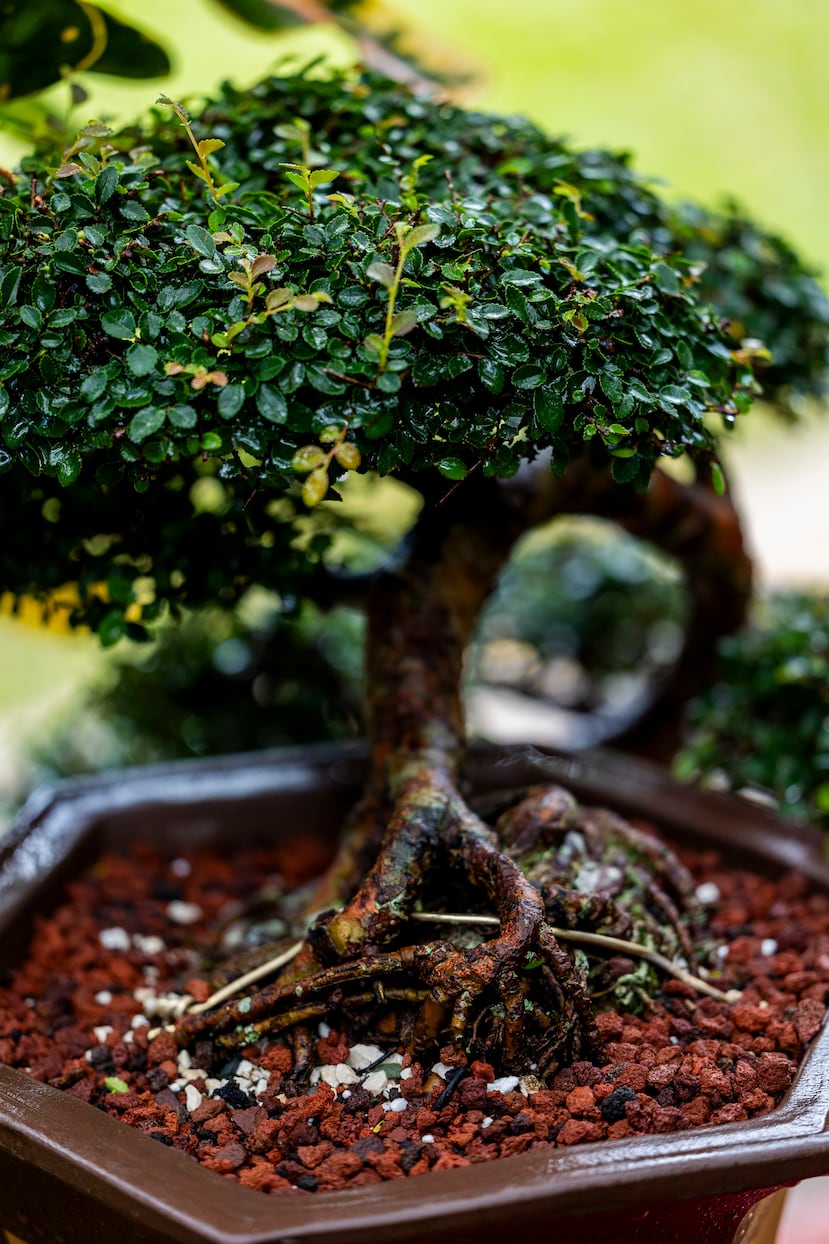
“We try to get merchandise, sometimes we get merchandise from the ground, plants that we grow in the ground, then we pull them out and turn them into bonsai or we get plants from nurseries, gardens,” he said.
Meanwhile, he explained that “it becomes a bonsai with pruning, a tray, and a lot of patience. The branches also have to be wired to direct them to where I want them to be.”
“A bonsai can be up to eight or ten feet tall, the important thing is that it is in a tray because if it is not in a tray it is not a bonsai. The smallest can be three to four inches. The tallest we have worked with is the cheflera, which we have taken out of the ground and turned into a bonsai,” he said.
“One of the first ones we made was four feet tall, a trunk that is 20 inches wide. But we give our clients guidance on how to take care of it, where to put it, what fertilizer it should have and what to apply,” he said.
Although the tradition of planting bonsai in trays originated in China, “this technique was adopted by Japan and thus spread throughout the world.”
It is worth noting that, for some cultures, bonsai represents spiritual balance, fortune and relaxation. In addition, it is a way of establishing a special contact with nature.
“Bonsai is an art that we really fell in love with because it gives us so much peace and tranquility as a family. We explain it to those we sell it to and it also helps many people with their emotional peace,” he revealed.
“But it is something that gives us a lot of peace, a lot of tranquility and I would say that it is even medicinal. I don’t have preferences because I like them all,” he concluded.
For details: 787-613-5905.

