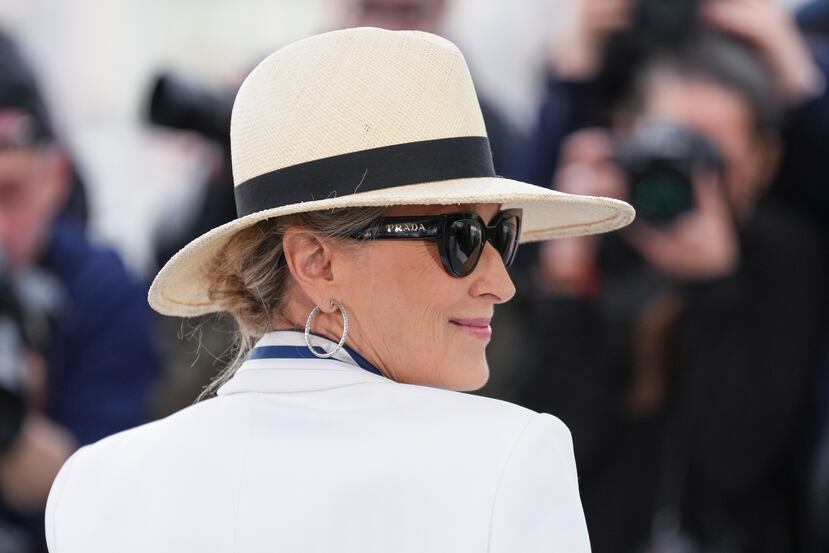
Drama or comedy, lead or supporting, it doesn’t matter what role the great lady of Hollywood plays. Meryl Streepat 75 years old, continues to shine in all the genres and formats he tackles, beyond its three Oscar, a record 21 Academy Award nominations, nine Golden Globes and two BAFTAs.
Considered one of the best actresses in the history of celluloid, this American could hardly have imagined when she moved from New Jersey to New York with very little hope of success that almost half a century later the public would have surrendered to her feet in every step she has taken in film, theater and television.
Born on June 22, 1949 and a graduate of Yale University, she began her career in New York theaters and made her film debut in the late 1970s with Fred Zinnemann’s film “Julia.” Since then, she has played some of the most memorable characters in the seventh art in more than 60 films.
Specializing in both vulnerable and strong female roles and characterized by her versatility, she relies, according to critics, on her ability with accents, demonstrated in her impeccable British English when she played Margaret Thatcher in “The Iron Lady,” or the Danish accent of the writer Karen Blixen, whom she brought to life in “Out of Africa.”
Elevated to the status of a cinematic legend, the three Hollywood statuettes won by the artist were for “Kramer vs. Kramer”, “Sophie’s Choice” and “The Iron Lady”, although she has eluded the fourth, which would go to another legendary actress, Katharine Hepburn.
From anonymity to the first Oscar
After her small role in Julia (1977), it was her role as Inga Weis in the television series Holocaust (1978) that marked her worldwide launch and for which she won the Emmy for Best Actress, her first major recognition.
That same year, she starred alongside Robert De Niro in Michael Cimino’s The Deer Hunter, earning her first Oscar nomination for Best Supporting Actress.
After her collaboration on Woody Allen’s “Manhattan” (1979), she won her first Oscar for Best Supporting Actress for “Kramer vs. Kramer” (1979).
For her first leading role, in “The French Lieutenant’s Woman” (1981), she received a BAFTA, the Golden Globe for Best Actress and her first Oscar nomination for Best Leading Actress.
This film was followed by “Sophie’s Choice” (1982), for which she won her second Oscar for Best Actress and the Golden Globe for Best Actress in a Drama.
Decades of success
Best actress of the 80s according to film critics, This decade produced many of her best performances, such as in “Silkwood” (1983) and “Out of Africa” (1985). She also produced Plenty (1985), directed by Fred Schepisi, and Ironweed (1987), for which she was nominated for an Oscar again.
In his filmography of the 90s he continued to reap successes with “Postcards from the Edge” (1990), “The House of the Spirits” (1993), based on the novel by Isabel Allende, or “The Bridges of Madison County” (1995).
Already in the 2000s he won in Berlin the Silver Bear for Best Actress for “The Hours” (2002) and “Adaptation.” For “The Orchid Thief” (2002) she won her fourth Golden Globe and a new Oscar nomination.
Although his entire career is written in capital letters, he has not hesitated to get involved in seemingly minor projects, such as “The Devil Wears Prada” (2006).
With an original, fresh and fun approach, she embarked on “Mamma mia!” (2008), a musical comedy with great hits by Abba, which entered the podium of the best musicals in the history of cinema and the highest grossing of all time, when she was almost 60.
The third Oscar goes to “The Iron Lady” (2011).
“Committed” to equality
A philanthropist and committed to defending women’s rights and gender equality, she has been a member of the advisory board of the organization Equality Now and in 2018, she participated in the documentary This Changes Everything, about gender discrimination in Hollywood.
Member of the American Academy of Arts and Letters and Commander of the Order of Arts and Letters of FranceStreep has received numerous honorary awards including the Cesar Award (France, 2003), the Donostia Award at the San Sebastian Film Festival (Spain, 2008), the Golden Bear at the Berlin Film Festival (Germany, 2012), the Stanley Kubrick Britannia (United Kingdom, 2015) and the Cecil B. DeMille Award (USA, 2017), among others, and was awarded the 2010 National Medal of Arts and the 2014 Presidential Medal of Freedom.
(ANDRES BALLESTEROS)
She was also awarded the Princess of Asturias Award for the Arts 2023 in recognition of her extensive film career and her tireless activism in favor of equality.
And as it could not be otherwise, with a resounding standing ovation, Meryl Streep received the Honorary Palme d’Or at the Cannes Film Festival last May for her career, returning to the Grand Theâtre Lumière 35 years later, when she was crowned best actress for “A Cry in the Dark.”