


Editor’s note: Don’t miss a single detail ahead of the 2024 elections in Puerto Rico. Visit our special site to keep you informed and Sign up here for the Pulso Politico newsletter.
Issues that captured public opinion this four-year period, such as the abortion and the rights of the LGBTQ+ communitywere excluded this Tuesday from a forum that religious sectors held with candidates for governor, in which the only two candidates who attended –Jesus Manuel Ortiz and Juan Dalmau– they defended the separation of Church and State.
According to the organizers of the forum, which took place in the Evangelical Seminary of Puerto Ricothe issues in question should not define who should lead the country from January 2025.
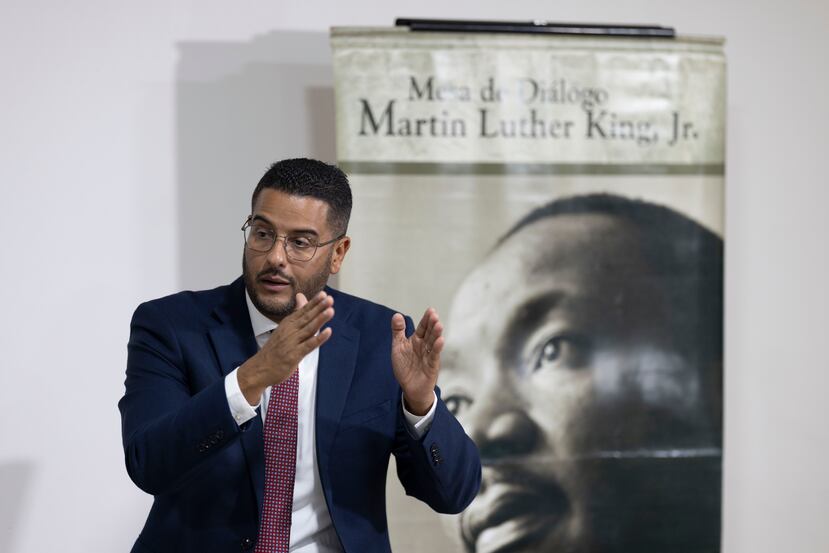
“As an organization, we have discussed these issues before, and we will not continue to stop doing so. But for us, what happens south of our navel and in private should not determine who will govern our country and, as communities of faith, we have to listen to what they think about everything, because everything affects us. The issue of sexuality (…) is not the only one that should lead us to decide (for whom to vote),” he said. Kelmadis Perezco-coordinator of the Martin Luther King Jr. Dialogue Table.
The Martin Luther King Jr. Roundtable is made up of activists and religious and secular leaders from different denominations, and therefore they do not necessarily share the same views on issues such as abortion and sexuality. They do, however, agree on the urgency of addressing the problems that affect the quality of life of citizens.
Therefore, Dalmau, from the Puerto Rican Independence Party (PIP), and Ortiz, from the People’s Democratic Party (PPD), were approached about the separation of Church and State, but also about their styles of governance, economic development, the future of the University of Puerto Rico, the energy crisis, poverty, health and electoral transparency. Each had 30 minutes to present their ideas.
The candidate of the New Progressive Party, Jennifer Gonzalezwas absent due to official business in Washington as resident commissioner, while the candidate for Dignity Project, Javier Jimenezcancelled his participation in the morning because something “unforeseen” came up, Perez shared.
The work of the Church
The forum, which started around 1:30 pm, began with the PIP candidate, who argued that the separation of Church and State, according to the Constitution of Puerto Ricoaims to respect the autonomy and independence of the role of each of the sectors in society.
“It was the idea that the State should not impose a preferred religion over other religious manifestations nor should the State use its power to censor, stifle or eliminate religions. “So I see that concept of separation of Church and State as one of mutual respect,” Dalmau said, acknowledging the role of faith groups in times of greater vulnerability, such as the impact of the Hurricane Mariain 2017.
“I don’t see it as a contentious divorce, on the contrary, I see it as a complementary coexistence. That is, The State must be aware that the faith sectors, the Church in its various manifestations, occupy spaces where the State is not able to reach.“, he added.
Asked about his religious experiences or ties to faith communities, Dalmau said he grew up in a Catholic family. But he admitted that the “defining” moment in his life was the cancer diagnosis of his son, Gabriel, in 2016, when he was 12 years old.
“I was bewildered, but the support of so many people who stopped us to tell us that they were praying for Gabriel, that they were praying for us, that gave us a strength that naturally complemented the scientific treatments.But without that other balance, we would have been in the air,” he said. “That was a transformative moment,” he added.
Dalmau was followed by the PPD candidate, who described the separation of Church and State as a guarantee that no one uses power to persecute, detain or impose beliefs. This, however, does not prevent the religious sector from expressing an opinion on the government’s public policy, he said.
“The Christian community has the right to express its opinion and say how they see the operation of their government. What we have to avoid is that neither one side nor the other has oppression because of the way a person may think.”he explained.
In his case, he shared that he was raised in “the gospel.” He mentioned that he attends church, although “not as regularly as one should.” “I am a believer and I feel comfortable with the dynamics of participating in the church. Of course, I am very clear about what my role as governor will be… that I represent the entire country,” he said.
Preserve the guarantees
After the forum, Dalmau and Ortiz addressed the issue of abortion in a press conference, and agreed that the State must guarantee the conditions indicated to those who decide to end a pregnancy.
“I believe that the legislation, as it stands, has not created a health crisis in Puerto Rico and, therefore, has been able to create that equilibrium and that balance.in terms of when a woman is faced with that determination, can do so in consultation with your primary care physician or your obstetrician-gynecologist,” said Dalmau.
Ortiz, who holds a seat in the House of Representatives, acknowledged that, during this four-year term, the issues of abortion and the rights of the LGBTQ+ community were used to polarize public opinion.“I think the goal was to maintain a spirit and a continuous atmosphere of confrontation, and I think we have to return to the reasonableness of a government that respects the rights of everyone and that makes its decisions based on what our responsibility is,” he said.
Regarding abortion, she said that it is a decision that each woman must make together with her doctor.“What the country should strive for is to have a country where a woman is not in the position of having to make a decision like that, which is hard and shows a country with a lot of inequality,” she said.

