


Tel Aviv, Israel — The Israeli army chief said on Wednesday that Forces are preparing for a possible ground incursion into the Lebanonafter Hezbollah fired dozens of projectiles towards Israelincluding one aimed at Tel Aviv which was the deepest released by the group so far.
Addressing soldiers on the northern border, Chief of Staff Lt. Gen. Herzi Halevi said the recent airstrikes were designed to “prepare the ground for their possible entry and to further degrade Hezbollah.”
In apparent reference to the missile aimed at Tel Aviv, he said: “Today Hezbollah expanded its range of fire, and later today you will receive a strong message, so be prepared”.
In order to achieve the goal of allowing residents of northern Israel to return to their homes, “we are preparing the process of an exercise,” he said.
The statements came after Hezbollah launched dozens of projectiles at Israel, including the missile aimed at Tel Aviv that was its largest attack to date and marked a new escalation of tensions following Israeli attacks that left hundreds dead in Lebanon.
Then on Wednesday, the Israeli military said it was activating reserves in response to heightened tensions with Hezbollah, and indicated it was preparing for a possible ground operation in Lebanon.
On the other hand, the Lebanese Minister of Health said that 51 people were killed and 223 injured in Israeli airstrikes on WednesdayThis adds to the 564 dead and more than 1,800 injured in the previous two days, including around 150 women and children.
The minister, Firas Abiad, did not give a breakdown of how many women or children were injured on Wednesday.
The Israeli military said it intercepted the ground-to-ground missile, which triggered anti-aircraft alerts in Tel Aviv and central Israel, with no casualties or material damage reported. The military also said: attacked a location in southern Lebanon from which the projectile had been launched.
Hezbollah said it fired a Qader 1 ballistic missile at the headquarters of Israel’s Mossad intelligence agency, blaming it for a recent spate of targeted assassinations of its top officials and last week’s bombings in which bombs hidden in pagers and walkie-talkies killed dozens of people and wounded thousands, many of them members of the political-paramilitary group.
According to the Israeli army, it was the first time that a projectile fired from Lebanon had hit central Israel. Hezbollah claimed responsibility for an airstrike on an intelligence base near Tel Aviv last month, but there was no confirmation. The Palestinian militant group Hamas repeatedly attacked Tel Aviv in the early months of the Gaza war.
On the other hand, the Office of the UN for the Coordination of Humanitarian Affairs said that More than 90,000 people have been displaced by five days of Israeli airstrikes in Lebanonand that the number of displaced people since Hezbollah began firing rockets at Israel almost a year ago has risen to 200,000.
The launch raised tensions in a region that appears to be heading toward another all-out war, as Israel continues to fight Hamas in the Gaza StripA wave of Israeli attacks in Lebanon on Monday and Tuesday killed at least 560 people and forced thousands to seek shelter.
Entire families have fled the south of the country and have reached the capital, Beirut, and the coastal city of Sidon, where they are sleeping in schools converted into shelters, as well as in cars, parks and beaches. Some tried to leave the country, causing a traffic jam on the border with Syria.
Hezbollah’s latest actions included dozens of rockets fired Wednesday toward northern Israel, the military said. Two people suffered shrapnel wounds in the agricultural community, or kibbutz, of Saar, according to Israel’s Magen David Adom emergency service.
Israel responded with a new wave of attacks against Hezbollah:At least three people were killed and nine others injured in an incident near Byblos, according to the Ministry of Health Lebanese. The coastal city is north of Beirut and far from the group’s main strongholds.
The Israeli military says it has no immediate plans for a ground invasion, but declined to give a timeline for its air campaign.
Tensions between Israel and Hezbollah have escalated steadily over the past 11 months. Hezbollah has fired rockets, missiles and drones into northern Israel in solidarity with Palestinians in Gaza and its ally Hamas, which is also backed by Iran.
Israel has responded with increasingly intense airstrikes and the killing of Hezbollah commanders, while threatening a broader crackdown.
He United Nations Security Council scheduled an emergency meeting on the situation in Lebanon for Wednesday at the request of France.
Nearly a year of fighting between Hezbollah and Israel had displaced tens of thousands of people on both sides of the border before this week’s escalation. Israel has vowed to do whatever is necessary to ensure its citizens can return to their homes in the north, while Hezbollah has said it will keep up its rocket attacks until a ceasefire in Gaza is reached, something that seems increasingly remote.
The rockets fired in the last week have disrupted the lives of more than a million people in northern Israel.where schools were closed and public gatherings were limited. In the coastal city of Haifa, many restaurants and businesses were closed and there were fewer people on the streets. Some of those who fled south from communities near the border are again under rocket fire.
Israel has moved thousands of soldiers from Gaza to its northern border. It says Hezbollah has around 150,000 rockets and missilesincluding some capable of striking any part of Israel, and that the group has fired some 9,000 projectiles and drones since October.
Lt. Col. Nadav Shoshani, an Israeli military spokesman, said the missile fired Wednesday had a “heavy warhead,” but he offered no further details or confirmed it was the weapon described by Hezbollah. He also called the group’s claim that it had attacked the headquarters of the Israeli military “unconventional.” Mossadlocated just north of Tel Aviv, of “psychological warfare.”
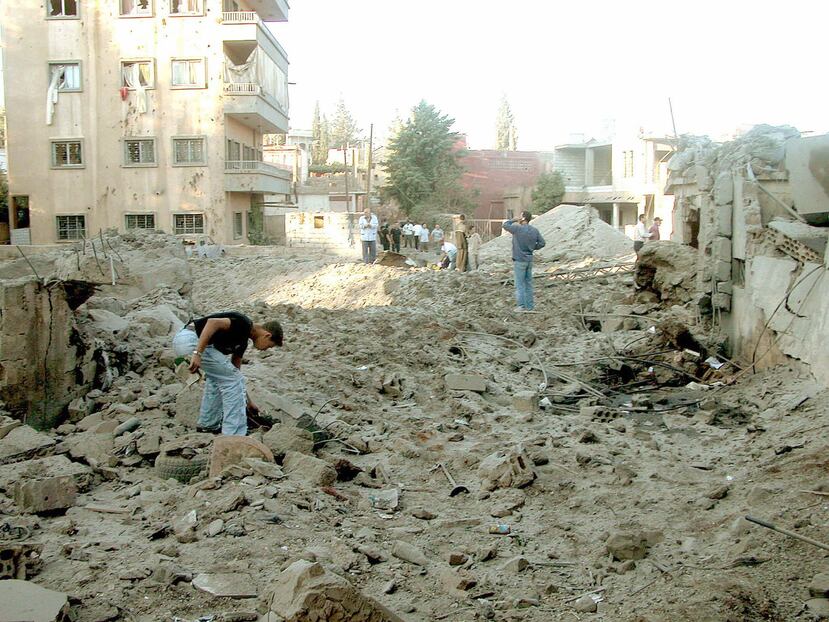
(IBRAHIM NOUR)
The Iranian-made Qader is a medium-range surface-to-surface ballistic missile with multiple types and payloads. It can carry an explosive payload of up to 1,760 pounds, according to the Center for International Strategic Studiesbased in WashingtonIranian officials have claimed the liquid-fueled missile has a range of up to 1,240 miles.
Cross-border attacks began to intensify on Sunday after a wave of explosions on tracking and communication devices left 39 dead and nearly 3,000 injured.many of them civilians. Lebanon blames Israel, which has neither confirmed nor denied its involvement.
An Israeli airstrike in Beirut on Tuesday killed Ibrahim Kobeisi, whom Israel describes as a senior commander in Hezbollah’s rocket and missile unit. Military officials said Kobeisi was responsible for the launches into Israel and that he planned an attack in 2000 in which three Israeli soldiers were kidnapped and killed. Hezbollah later confirmed his death.
It was the latest in a series of killings and setbacks for the group, which is the country’s largest political and military force and is considered the Arab world’s leading paramilitary force.
The Lebanese Ministry of Health reported that six people were killed and 15 others were wounded in an attack on a southern suburb of Beirut.an area where Hezbollah has a strong presence. The National News Agency said the attack destroyed three of the six floors of an apartment building.
Hezbollah fired 300 projectiles on Tuesday, wounding six Israeli soldiers and civilians, most of them lightly, the Israeli military said.
According to the Lebanese Ministry of Health, At least 564 people have been killed in Israeli attacks since Monday, including 50 children and 94 women, and more than 1,800 have been injured.

