


After numerous performances, in five countries, that told the story of Lolita Lebron, the play “Lolita: a monologue about the life of Lolita Lebron”will go to the big screen as a film that intertwines the artistic fusion between cinema, theater and poetry.
“Between the Scream and the Cell,” the name of the film adaptation, will be presented on October 10 in select Caribbean Cinemas theaters to tell the story of the nationalist leader Lolita Lebron with a more intimate twist on the most important moments in the activist’s life.
“From the beginning when the original monologue was written, there is a lot of political Lolita, but beyond the political figure 11 years ago, when we began the investigation, and we connected with Lolita’s younger sister, Aurea Lebron and with Linda Alonso Lebron , her niece, at that time, were alive and were integrated into the project from the beginning and, through those conversations with them, we ourselves became closer to the figure of Lolita beyond politics and learning about her anecdotes, her family, her stories as a wife, as a mother,” explained the film’s producer, Viviana Torres Mestey.
The film is an adaptation of the play “Lolita: a monologue about the life of Lolita Lebron” and the original script of the artistic piece is maintained, but what they called “experimental cinema” is added.
“Firstly, because the story is not told in a linear way and not everything is told realistically, but we go from the story with his real physical body in a cell and there are some images, on a mountain, as if it were his free mind. So we go in the game from what she is actually saying to what she is thinking. Second, because it is still an adaptation of passive theater,” reported the professor from the University of Sagrado Corazon.
Likewise, the film “Between the Scream and the Cell” highlights the role of a woman who remained firm in her beliefs and who fought for justice, even though Lolita Lebron had to sacrifice spending time with her family and her interpersonal relationships. .
“I think that Lolita is an example of how women, on many occasions, have to unfold ourselves into different roles, above all, the public role, the face we give to people, versus the private role and our life with our families. families, in our homes, in our privacy,” said Torres Mestey, who also stars in the role of the nationalist leader.
The actress shared that the most striking thing about the activist’s character was her stoicism and how willing Lolita Lebron was to fight for the good of Puerto Rico.
“You have to be stoic in the face of pain, that is, no matter how much they try to break you, Lolita suffered a lot while she was in prison and we see it in the film too, to break your soul and break your heart. If you remain stoic and firm with your beliefs and what you believe, you will show that,” he added.
“It is an example”
Lebron has been widely recognized as an inspiring political figure and has created an impact on Puerto Rican women, as the leader has proven to be an example for the advancement of women’s rights.
“Somehow, as a Puerto Rican woman, it is important for me to have that example of bravery and courage beyond the political issue, beyond political affiliations, that a woman has had such a strong conviction to sacrifice her family ties, to sacrifice her intimate life, her interpersonal relationships with her family, with her partner to advance a greater cause for her homeland because she firmly believed that the freedom of Puerto Rico was going to give her children a better future. In other words, her going to sacrifice her life and giving her life was doing it, ironically, for her children and for future generations,” the photographer also pointed out.
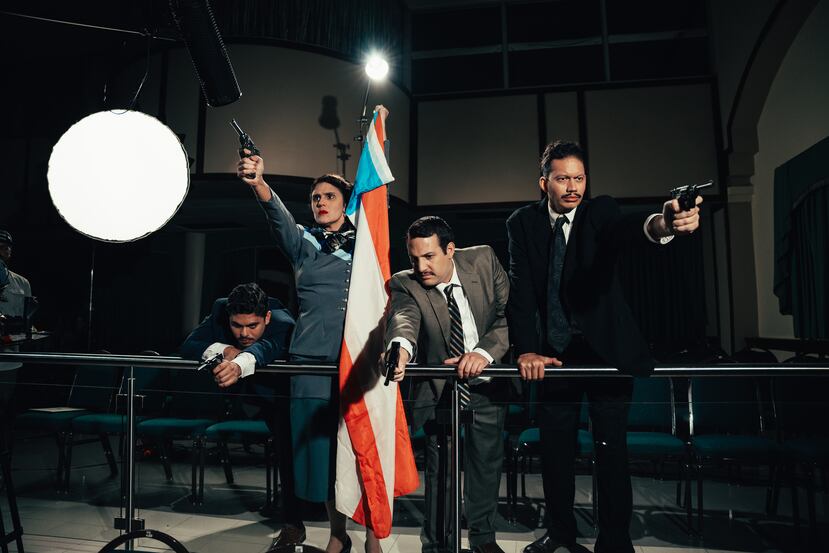
Torres Mestey stressed that “it is an example” of the courage with which Lebron fought for the liberation of the island and the progress that was made so that Puerto Rican women could have the possibility of dialogue in freedom.
“Between the Scream and the Cell” Team
As part of the cast of the film, the Puerto Rican actors who participated are: Giomar Cruz, One Colon, Alberto Mateo, Jianna Pagan, Orlando Rodriguez, Jorge Alexander, Gian Lucas Rivera, Irmaris Rodriguez, Efrain Rosa, Hector Sanchez, Berna Torres, Geigel Torres and Viviana Torres Mestey.
The cinematography was in charge of Reynaldo Torres Casas and the adaptation was based on the original script by Waldo Torres Vazquez, father of producer Viviana Torres Mestey. Likewise, the film was directed by Efrain Rosa.
Finally, Luis Daniel Cartagena and Vivian Mestey, mother of the film’s protagonist, worked in the Art Department. In the Technical Department, Nathanael Morales, Darline Lozada and Harrison Haley, other artists and filmmakers from the country, were in charge.
Cinemas where you can see it:
- Plaza Las Americas
- Guaynabo Square
- Sun Square
- Plaza Escorial
- Montehiedra
- Cayey Cinemas
- Ponce Town
- San German Cinema
- Western Plaza Mayaguez
- Barceloneta Outlets

