

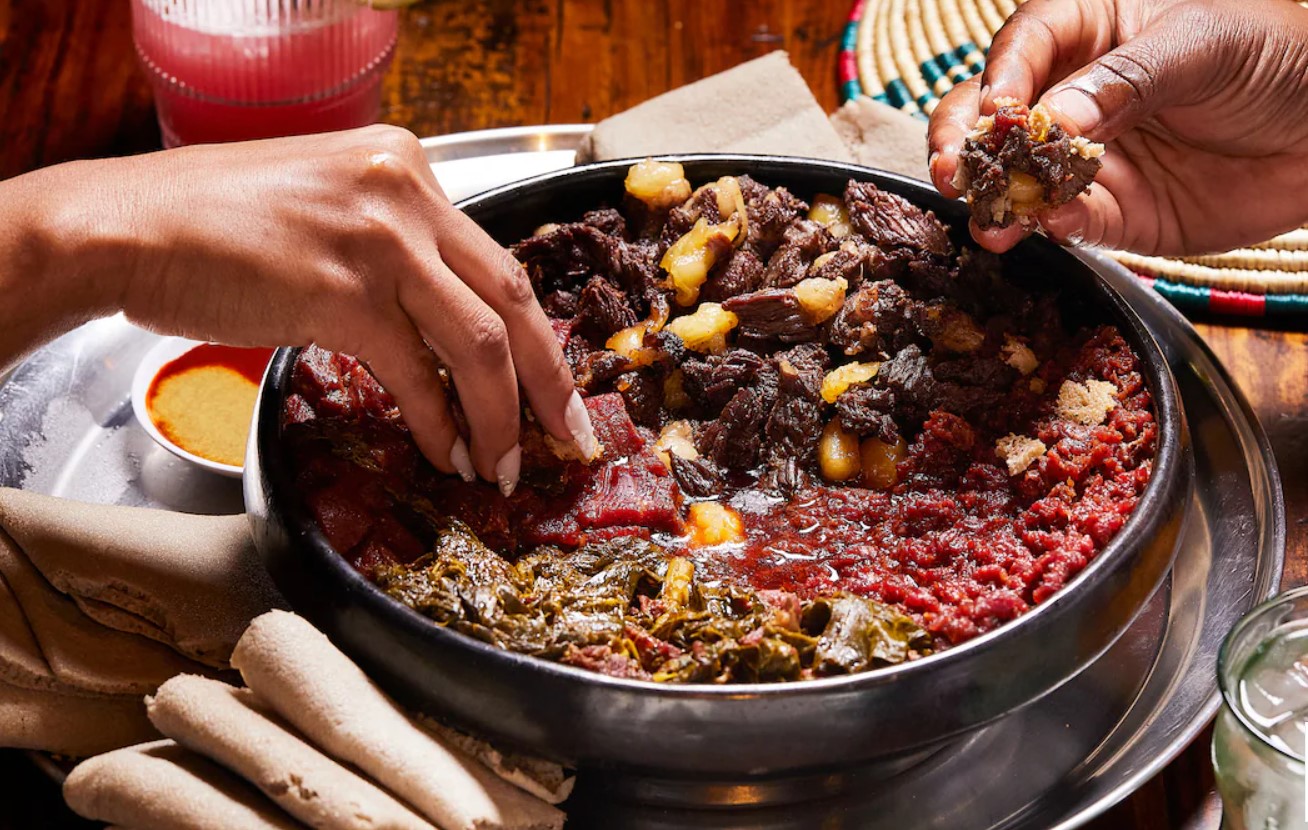
The region is home to the largest Ethiopian population in the United States, which translates to a lot of good restaurants.
Among my favorite comfort foods is anything Ethiopian displayed on injera, one of the world’s most versatile breads.
Quick, name another food that also doubles as canvas and utensil. Tangy, a little spongy, nicely elastic and plenty delicious, crepe-like injera negates the need for forks and knives. The best is made with the protein-rich grain teff and comes freckled with “eyes,” or tiny holes on the surface. Think of injera as the ultimate finger food.
Happily, there are plenty of opportunities in and around Washington to tear swatches of injera from their scrolls and wrap the pieces around a salad or stew. That’s because the region hosts the largest population of Ethiopians in the United States, according to the 2024 World Population Review.
Unrest around the world tends to bring good food to the nation’s capital. Ethiopians began settling in the District after the overthrow of their emperor, Haile Selassie, in 1974. Low rents saw Ethiopian restaurants pop up first in Adams Morgan, then in other neighborhoods, including Shaw, and in Maryland and Virginia. As the cost of doing business increased, Ethiopian operators decamped for more affordable spots in the area.
Ethiopian is one of my choice cuisines in part because its flavor profile is similar to Indian, my No. 1 pick if I had to choose the cooking of just one country. Then there’s the entertainment factor. A meal in an Ethiopian restaurant unfolds like dinner and a show, thanks to the way the colorful dishes are staged on a round platter lined with injera — a kaleidoscope comes to mind — and the use of fingers to ferry bites from plate to mouth.
Ethiopian cooking is also something people with different appetites can get around, given the way meat and vegetables are treated as equals. Fasting periods, during which Orthodox Christians abstain from meat, eggs and dairy, are taken seriously in Ethiopia, writes Yohanis Gebreyesus in the cookbook “Ethiopia: Recipes and Traditions From the Horn of Africa.” There are about 250 fasting days annually in Ethiopia; the observant don’t eat until 3 p.m. those days.
Finally, at a time when restaurant prices are going up, up and away, and federal workers in particular are concerned for their jobs, the cost of a meal at an Ethiopian establishment remains grounded. Even in upscale restaurants, most entrées are under $20, and often shareable. (The availability of combination platters in many Ethiopian purveyors settles arguments before they even start.)
Reviewing all the area’s many Ethiopian sources would be nearly impossible for a single diner, at least one whose job obliges him to pay attention to restaurants representative of all parts of the globe. Still, I ate at a couple dozen places to come up with the following list. If you live around Washington, chances are good at least one of my picks is nearby — and maybe one of them becomes part of your restaurant routine.
Beteseb Restaurant
The physical menu — shaped like a half-moon and vibrant with life-size food photos — makes you smile as it whets your appetite. Open the spiral-bound document, and it assumes the form of a typical injera-dressed platter. Fun!
The dining room is equally attractive, with walls painted the shade of yellow lentils and a corner devoted to displays of woven baskets and wine. A silver-toned silhouette of Addis Ababa on one wall adds to the storefront’s appeal.
Home in on one of the best vegetable combinations for miles, a vivid painter’s palette that includes shiro, the loose-textured chickpea flour stew shot through with onion, garlic and berbere. And if you like steak tartare, you’ll love the kitfo, bright as a fistful of rubies and fueled with turmeric and black pepper, among other spices. (Generally eaten raw, or tere, the famous beef dish can be lightly cooked, lebleb). Co-owner Darmyelesh Alemu also serves as chef and thinks decade-old Beteseb sets itself apart from the Ethiopian pack by putting “focus on serving food, not other stuff” such as entertainment.
Like most of the competition, this one is easy on the ears. Classical jazz, played at a level you notice but that doesn’t inhibit conversation, elevates the eating.
CherCher Ethiopian Restaurant
Return to menu
CherCher is inspired by a mountainous region in eastern Ethiopia, revered for its coffee and meat, says Alemayehu Abebe. He’s the owner of three same-named restaurants, the original of which, opened in 2012, spreads 100 seats across three floors in Shaw.
Sure enough, when I ask for some direction from a gracious server at the senior spot, fragrant with incense, she steers me to No. 15 and No. 24 — beef and lamb — on the menu. The first is strips of explosively juicy short ribs tangled in sweet onions and hot jalapeños; the latter is tender lamb in a fire-red stew that lets diners ratchet up the heat with accompaniments of mitmita, awaze and mustard seeds.
Yebeg wat (lamb stew) from CherCher. (Shawel Tadesse/CherCher Ethiopian Restaurant)
The sibling dining rooms have served me equally well, with a fetching vegetable combination platter (love the zesty red lentils and wizened green beans with carrots) on 14th Street NW and cardamom-scented kitfo in what looks like an art gallery in Bethesda.
The secret to the consistency among the three restaurants? The stew-based cooking in the largest kitchen on 14th Street, the source of fresh-made injera on Mondays and Fridays, helps. (A van transports the goodness from branch to branch.) So does the owner’s commitment. “I taste everything,” says Abebe.
1334 Ninth St. NW. 202-299-9703. chercherrestaurant.com. The other branches are at 3608 14th St. NW and 4921 Bethesda Ave., Bethesda. Entrées $14 to $24.50.
Eatopia Eatery
Veggie combo plate.
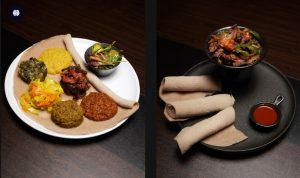
Special tibs.
A fresh face on the food scene, this U Street storefront was designed to fill a need for an upscale Ethiopian experience, says owner Surafel Gizachew. His dining room is dressed for date night, with paintings from half a dozen Ethiopian artists, while the menu offers fancy cocktails created by the lead bartender, Engidawork Alebachew, at Bourbon Steak in the Four Seasons in Georgetown.
Aiming to serve food “as close as back home,” Gizachew, a native of Addis Ababa, flew his 67-year-old mother in for four months so she could train the kitchen staff, now headed by the owner’s wife, Eden Yimer. Her “special” tibs feature tenderloin rather than the more common rib-eye, and it’s delicious to find nonmeat versions of some Ethiopian culinary traditions. The menu includes a kitfo coaxed from diced ahi tuna, lush with olive oil instead of spiced butter, and tibs rethought with sauteed portobello mushrooms that mimic the texture of beef. Out of respect to famous Ethiopians or District denizens, he names some dishes after them. Haile Selassie, Dave Chappelle and his parents all get shout-outs.
The owner, a former DJ known as “Djphatsu,” entices customers with music as well as food. Live jazz is performed Monday and Thursday through Saturday beginning at 7 p.m. No less than Herb Scott, a staple at Mr. Henry’s and elsewhere, played his saxophone for diners on a recent visit.
Gizachew thinks big. The owner is already scouting locations for another Eatopia in Arlington, and he hopes to expand the brand with copies in New York, Los Angeles, Dubai and, eventually, Ethiopia. Coals to Newcastle? More like full flavors coming full circle.
1301 U St. NW. 202-930-6799. eatopiaeatery.com. Entrées $22 to $26.
Makeda
Return to menu
Chef Senait Tedla at Makeda. (Scott Suchman for The Washington Post)
“How could you not want to eat that?” a wide-eyed friend of Ethiopia says as dinner is brought out, half a dozen vivid vegetables and stews arranged on a swath of injera.
We briefly pause to admire the edible canvas before plunging into the spread: deep golden cabbage, zesty red lentils that make your scalp itch from the spice, a rosy mound of kitfo that replaces the usual minced raw beef with raw tuna. The fish — slick with olive oil, fragrant with cardamom and fiery with mitmita — does what the chef, Senait “Mimi” Tedla, intends: “It makes you feel good,” she says of her enlightened version of the Ethiopian classic, whose flames typically come from spiced butter.
Salmon goulash at Makeda. (Scott Suchman for The Washington Post)
Makeda, its name a reference to the biblical Queen of Sheba, is full of pleasures. A request for tej produces a lovely honey wine made by a local producer. Some of the best gored gored in the area is found here; strips of filet mignon, so soft you barely need to chew, arrive in a spicy, brick-colored cloak of awaze, Ethiopia’s answer to hot sauce. Salmon goulash? The dish is based on a recipe Tedla’s mother made for her father, who grew up in Italy. Cubes of fish cooked with onions, garlic and rosemary demonstrate the chef’s passion for Mediterranean flavors (in another life, she cooked in Israel).
Meals unfold in a dining room dressed with paintings from Addis Ababa and offering live entertainment almost as often as a full-fledged club. On a recent visit, I asked after the chef, who happened to be off for the night. The queen of the kitchen should be pleased to know dinner tasted as if she were holding court.
516A S. Van Dorn St., Alexandria. 571-312-7606. makedarestaurant-va.com. Entrées $13 to $23.
Meaza Restaurant
Return to menu
The vegetarian combination at Meaza. (Deb Lindsey for The Washington Post)
More than a thousand pieces of injera are served on busy weekends when this sprawling restaurant, which also caters, hosts weddings and other special events. Early in the life of the establishment, which includes a bakery, Meaza sold some of the injera it produced. Twenty-five years after Meaza Zemedu opened her namesake business, it’s so busy the owner buys some of the tangy crepe-like flatbread from other sources.
I like to visit on a weekday, when the circular tiered dining room is hushed and it might be just me and a few other customers for lunch. My habit is to order the vegetable sampler and round it out with a meat dish, sometimes the signature Meaza tibs: beef cooked with onions, jalapeños and garlic followed by the racy spice blend mitmita. The house side dish — cool shredded cabbage and onion sharpened with vinegar — is the perfect companion to the sizzling meat, served with ceremony from a trolley rolled up to the table.
The mural of the waterfall depicts one of two sources contributing to the Nile River, and the walls opposite feature framed portraits of some of Ethiopia’s past leaders — geography and history lessons every time you look up from your linen-draped table.
Zemedu attributes a quarter century in business to “being there” every day and never serving food when “it’s just okay.” I like the way she thinks and admire how Meaza tastes — every visit.
5700 Columbia Pike, Falls Church. 703-820-2870. meazarestaurant.com. Entrées $11 to $19.
Nazret Ethiopian Restaurant
Return to menu
Sambusas with mixed salad at Nazret in Falls Church. (Yetemgeta Zewdu/Nazret Ethiopian Restaurant)
The packed dining room I encounter every visit can be explained by the fact that owner Endalkachew Mekonnen is not only the chef, he also ran his own cooking school in his native Addis Ababa for three years, during which time 600 students graduated.
Mekonnen sweats the small stuff, buying only fresh meat, grinding his own spices and changing his cooking oil every few hours. Tomato paste is the only ingredient he says he buys in a can. Some restaurants buy their sambusas. Nazret not only makes its lentil-filled turnovers from scratch, but Mekonnen pairs them with a green salad whose spark comes from lemons he pickles for the dressing.
The chef’s signature dish is golden tibs, short ribs cooked in oil and finished with fresh rosemary, tomatoes and onions. The crisp-tender hunk of meat is best rounded out with Nazret’s colorful vegetable sampler, the elements of which benefit from the warm spices Mekonnen grinds. The bites of beef are primal and good on their own, racier with a dip in the accompanying sauces, including mitmita and berbere. Nazret is a busy kitchen: The chef, whose brother serves as manager, goes through 800 pounds of onions alone.
Takeout accounts for about 30 percent of business here. Nazret doesn’t deliver, though. Mekonnen prefers that customers see where their food is coming from — another way one of the best purveyors of Ethiopian in the area personalizes his brand.
3821 S. George Mason Dr., Falls Church. 703-347-9911. nazretethiopianrestaurant.com. Entrées $14 to $20.
Shalla Restaurant & Bar
Return to menu
Chef Tsega Amera in the kitchen at Shalla in Silver Spring. (Hector Emanuel for The Washington Post)
Named for a popular lake in south-central Ethiopia, this youthful restaurant takes meat seriously. Shalla’s two full-time butchers process up to five cows a week when customers aren’t fasting during religious holidays, says Temesgen Gebeyehu, one of three owners, all from construction backgrounds.
The bestseller on the menu is shint tibs — a heap of juicy cubed rib-eye, sweet with onions and sharp with jalapeños — followed by the excellent kitfo, the upgraded version of which comes with housemade cottage cheese and wedges of kocho, made with the grated and fermented root of the ensete plant, a member of the banana family. Another first-rate uncooked dish, gored gored, gathers cubes of red beef made more colorful, and zesty, with the chile-charged spice blend berbere. Want less heat? Spring for alicha wot, chopped beef and sweet onions in light curry. Don’t eat meat? Ground tilapia jump-started with jalapeños is a good catch. And the fiery red lentils and crunchy, garlicky collard greens on the vegetarian sampler are models.
Dark and thick with incense, the dining room caters to a crowd that leans young and male, which Gebeyehu attributes to the trio of business partners. “We each have our crowd” that comes in to visit, says the greeter in chief. A giant TV screen packs them in on the weekend, when soccer matches are broadcast.
On a recent visit, female servers glided through the room in traditional white-and-gold dresses and a few diners were feeding one another small bites by hand. The practice, called gursha, is a sign of respect and a hallmark of a cuisine that’s rich with distinctions.
8081 Georgia Ave., Silver Spring. 301-920-0082. shallarestaurant.com. Entrées $12 to $22.

