

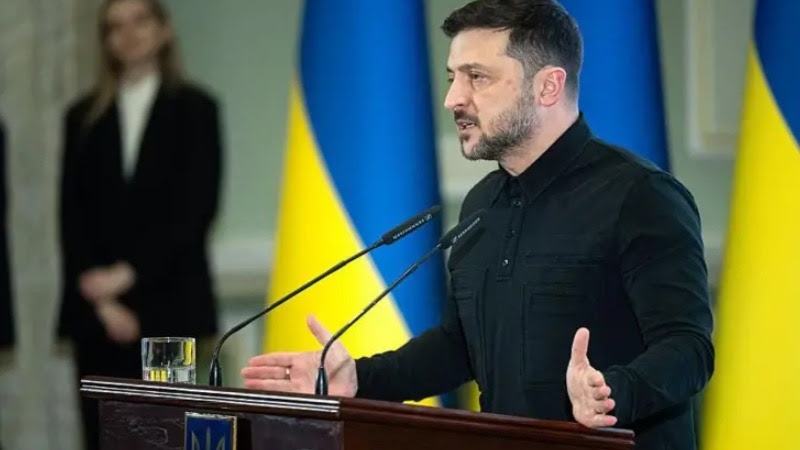
Zelensky said the 20 points agreed with the US offered Ukraine security guarantees that mirrored Nato membership.
Ukraine’s President Zelensky has shared details of an updated plan to end the war in Ukraine that offers the potential withdrawal of some Ukrainian troops. Giving details of the 20-point plan agreed by US and Ukrainian negotiators in Florida at the weekend, Zelensky said a demilitarised zone or a “free economic zone” was a potential option for the key issue of Ukraine’s eastern Donbas. He said the Russians would give their response once the Americans had spoken to them.
Describing the plan as “the main framework for ending the war”, he said it proposed security guarantees from the US, Nato and Europeans for a co-ordinated military response if Russia invaded Ukraine again.
On the key question of Ukraine’s eastern Donbas, Zelensky said a “free economic zone” was a potential option.
He told journalists that as Ukraine was against withdrawal, US negotiators were looking to establish a demilitarised zone or a free economic zone. Any area that Ukrainian troops pulled out of would have to be policed by Ukraine, he stressed.
“There are two options,” Zelensky said, “either the war continues, or something will have to be decided regarding all potential economic zones.”
The 20-point plan is seen as an update of an original 28-point document, agreed by US envoy Steve Witkoff with the Russians several weeks ago, which was widely seen as heavily geared towards the Kremlin’s demands.
The Russians have insisted that Ukraine pulls out of almost a quarter of its own territory in the eastern Donetsk region in return for a peace deal. The rest is already under Russian occupation.
Sensitive issues including questions over territory would have to be resolved “at the leaders’ level”, but the new draft would provide Ukraine with strong security guarantees and a military strength of 800,000, Zelensky explained.

