

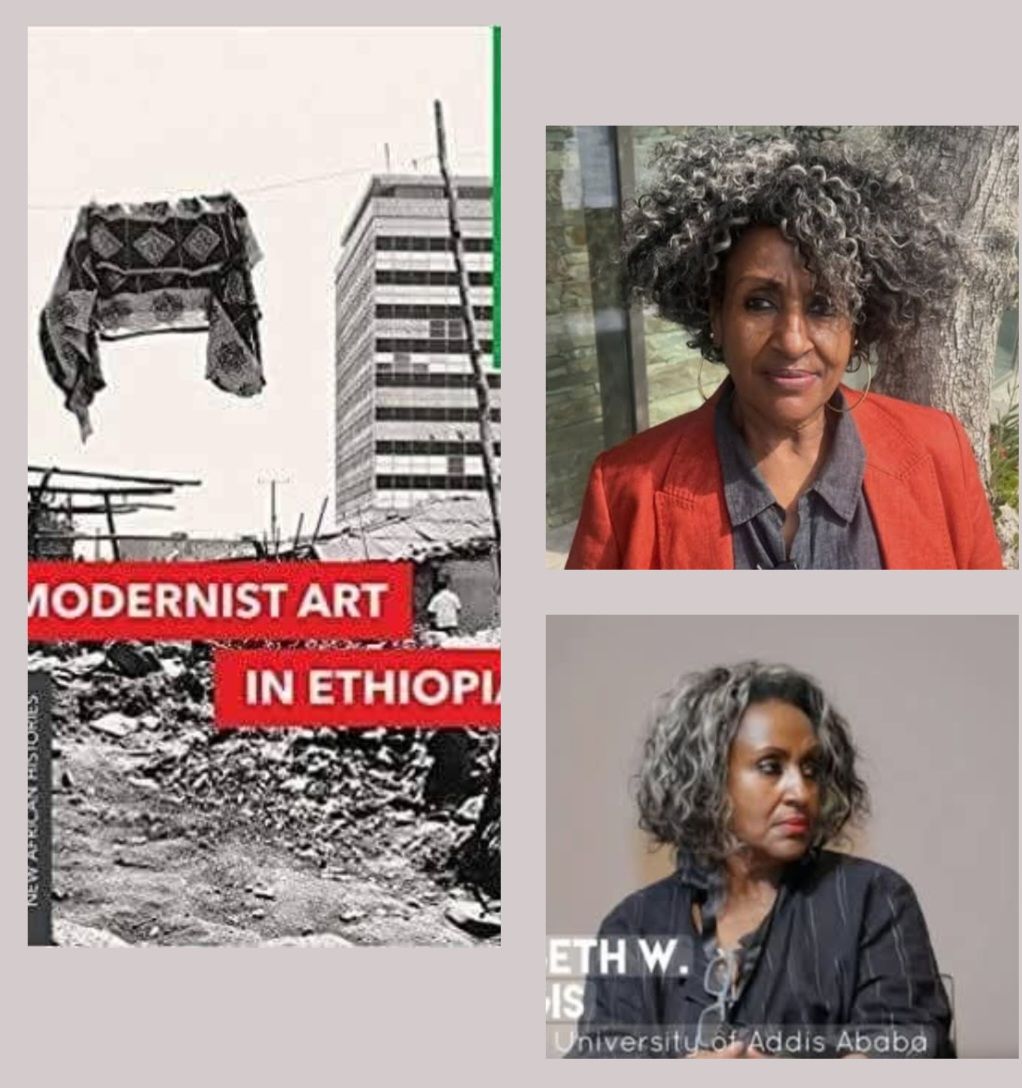
Book Title :- Modernist Art in Ethiopia
Author :- Elizabeth W/Giorgis (PhD)
page :- 339/A5
Genre :- Art History
I was always surprised to hear her talk about black art with a high level of fervent on sheger Radio. When I was perusing this book her sweet stuttering voice was playing in my head.Just to give you a cursory look into her credentials, Elizabeth W. Giorgis was a Professor of Art History, Theory and Criticism at The Africa Institute. She received her Ph.D. in the History of Art and Visual Studies from Cornell University (2010) and her Masters in Museum Studies from New York University (2004). She served as the Director of the Institute of Ethiopian Studies, the Dean of the College of Performing and Visual Art, and the Director of the Modern Art Museum: Gebre Kristos Desta Center at Addis Ababa University.
1 What is Modernity?
The book delves into the vibrant story of modern art in Ethiopia by stating how she met Eskunder Boghosian at his apartment. He had a huge bed in the middle of the living space with all sorts of his street findings heaped on and around it. From that point on she takes us into the minds and lives of modern artists. she explores a period between the 1900 upto now.The turn of the 20th Century was a time of tremendous change with the emergence of a modern Ethiopian state and the influence of global modern art movements.The book examines the work of artists like Afework Tekle, Skunder Boghossian, and Gebrekirstos Desta , who challenged traditional Ethiopian artistic conventions and embraced modern styles.It’s a great blend of art history and cultural studies.The book doesn’t just focus on the art itself, it also explores the social, political, and economic context in which these artists created their work. It’s a visually rich book with many stunning illustrations, literary texts, news paper reportage, poems (page .It helps bring art to life and adds another dimension to its experience.
Elizabeth defines Modernity as a period marked by a shift in worldview, moving away from traditional, religious, and feudal structures towards a more secular, rational and individualistic society.However she believes Ethiopian Modernity could not be entagled from “the larger political and ideological history of modernity”(page 4), with all its heinous baggage like colonialism. But, A key element of Modernity is the emphasis on reason, science, and progress, with that she tries depict the various ways of defining Modernity by showing the contrasting views of Andreas Eshete and Mesay Kebede(page 10 -12). As we all know Modernity is linked to the Enlightenment period (17th and 18th centuries) and its focus on critical thinking and human autonomy. Modernity is also associated with the rise of capitalism, industrialization, and urbanization, thats why most people confuse Modernization with Westernization. These economic and social changes fundamentally altered the way societies functioned. Kant is often considered a pivotal figure in the transition to Modernity. He emphasized the importance of reason and autonomy in shaping human understanding and experience.
2 . The ብርሃን እና ሰላም Intellectuals
In his work “What is Enlightenment ” he argued that reason should be the source of our knowledge, like wise modernists (1900-1957) who used to write on ብርሃን እና ሰላም( Light and Peace) Magazine championed reason and science .These intellectuals and authors were fascinated with the concept of Modernity.Notable painters being Belachew Yimer, Tasso Habtewold, Yohannes Tessema and Behailu Gebremaryam ( page 28). However, Hegel’s philosophy explored the historical development of reason and consciousness. He saw history as a process of dialectical progression, where ideas clash and synthesize into new, more complex understandings. For Hegel, Modernity represented a significant stage in this historical process, characterized by the rise of individualism and the development of self-consciousness. Thats why the concept of Modernity is loosely associated with Arada, “Poets and musicians employed the term(Arada) a symbol of and image if renewal, an inauguration of a new experience”(page39). Weber explored the social and cultural implications of Modernity, particularly the rise of bureaucracy, rationalization, and the “disenchantment” of the world. He argued that Modernity had led to a loss of traditional values and meaning, replaced by a focus on efficiency and technical expertise.
Early intellectuals like Fitawrari Derese Amente and Hakim Workineh Eshete often wrote disagreeing with each other but never wanted to let go of the old Ethiopia and yet wanted to create the new Ethiopia, often idolizing Japan. Power operates in Modernity, it is not simply a tool of repression but also a constitutive force that shapes knowledge, institutions, and our very understanding of ourselves. Artists after the liberation such as Blaten Geta Emaelaf Hiruy were Patriotic and royalists but Painters like Agegnehu Engeda derided the Monarch for fleeing the country. Modernity and its effects continue to be debated.Modern Intellectuals and Artists were a bridges between Art and Modernity. Antonio Gramsci saw art as a powerful tool for social change. He believed that intellectuals had a responsibility to challenge the dominant ideology and promote a new way of thinking that would lead to a more just and equitable society. Art for Gramsci wasn’t just about aesthetics; it was about raising consciousness and sparking revolution. Surprisingly, artists in the 1960’s caused an actual bloody revolution. But, Elizabeth calls them “The Prime of Ethiopian Modernism” (p 82) They thought artists could help people see the world in a new way and fight for social justice.
3. Addis Reporter , the new Medium
The once great platform like ብርሃንና ሰላም was replaced by Addis Reporter, she gives a detailed analysis of the article ” The Hyphenated Ethiopian” co authored by Gedamu Abreha and Solomon Deressa , published on Addis Reporter.These two also wrote another interesting article called ” Non Sequitur” highlighting our aversion to change. Michel Foucault was fascinated by the ways power and knowledge are intertwined. He believed that intellectuals had to be critical of all forms of power and their effects on people’s lives.But, the intellectuals of the 1960’s were divided into two those who were thought outside and those who graduated from HSIU(page95), those who came from abroad were reformists and the later ones were radicalists. Thats why, Art for Foucault was about questioning norms and exposing hidden power structures. He saw art as a space for resistance and subversion, a way to break free from the control of established institutions.On the contrary, Franz Fanon advocated decolonization and the liberation of colonized people. He believed that art could be a powerful tool for reclaiming cultural identity and resisting oppression.
4. Decolonization and Modernity
Modernity, particularly during the Enlightenment period, was fueled by a sense of European supremacy and a belief in the superiority of Western civilization. This mindset often justified colonization as a mission to “civilize” and “modernize” other cultures. That is why the Berhanena Selam to Addis Reporter evolution was refracted into various news papers like “Endih New”, “Challenge” and “Struggle” and intellectuals like Kifle Wedajo started advocating for PanAfricanism.Even older authors like Mengistu Lemma suggested change through his famous Poem ባሻ አሸብር በአሜሪካ but later on more radical Authors of አደፍርስ ፣ ከአድማስ ባሻገር እና እስቲ ጠየቁ raised radical and foundational questions. Modernity’s emphasis on capitalism, industrialization and the search for raw materials and new markets played a significant role in fueling colonialism but Ethiopians held a history of independence making it difficult to understand the global black struggle. European powers sought to exploit resources and establish trade networks across the globe.While often used to justify colonization, Enlightenment ideals of reason and human rights were also challenged by the realities of colonial oppression.
Colonization created global interconnectedness, leading to the exchange of ideas, cultures, and goods on an unprecedented scale. This process contributed to the development of Modernity as a global phenomenon. Colonialism also challenged the very foundations of Modernity. It exposed the hypocrisy of Enlightenment ideals when applied to colonized populations and it fueled resistance movements that fought against colonial domination and for self-determination. Decolonization is an ongoing process that’s why artist and intellectuals continue to play a vital role in challenging colonialism’s lasting legacies and creating a more just and equitable world. Their work is essential for inspiring hope and action for a better future. Many modern artists, like Pablo Picasso, Henri Matisse, and Paul Gauguin, were inspired by non-Western art, especially African art. They were drawn to its vibrant colors, geometric forms, and expressive power. Think of Picasso’s “Les Demoiselles d’Avignon” – it’s full of those angular shapes and flattened forms inspired by African masks and sculptures. By embracing non-Western aesthetics, these artists challenged the dominant Eurocentric view of art and helped to open up new possibilities for artistic expression. Albeit, Ali Mazrui was interested in the intersection of African cultures and globalized ideas. He saw art as a way to bridge the gap between different cultures and create a more inclusive and understanding world.Art for Mazrui was about dialogue and exchange . He believed that intellectuals had a responsibility to promote intercultural understanding and challenge narrow perspectives.
5. The Two Great Pillars
Colonization had a profound impact on the identities and cultures of colonized peoples, forcing them to navigate a complex interplay between their own traditions and the imposition of European norms and values.That’s when the two prominent artists Eskunder and a Gebrekirstos emerged, the black resistance movement coupled with radica Marxist and Leninist ideology.
It is unknown why Elizabeth give great emphasis to Gebrekirstos and Eskunder but I suspect its because Eskunder was her Mentor and she curated the GK museum in Addis Ababa. The process of decolonization, which began in the mid-20th century, challenged the Eurocentric understanding of Modernity and sought to reclaim agency for colonized peoples. Eskunder was highly involved in black art and struggle , specially in his Paris years(1957-66).Luckily, the students of Eskunder and GK , Zerihun Yetimgeta, Desta Hagos received the torch from their Mentors and became the pride and joy of the School of Fine Art. Postcolonial thinkers like Frantz Fanon, Edward Said and Gayatri Spivak have argued for alternative conceptions of Modernity that acknowledge the diversity of human experiences and challenge the dominance of Western perspectives.The legacies of colonialism continue to shape the world today, and the relationship between Modernity and decolonization remains a topic of ongoing debate and reflection.
6 Dergue and Art
The Dergue period(Enat Hager weym Mot) unfolded while most African countries were fighting for independence, the radical Marxist view coupled with famine and war forced artists to fall on oblivion for the great black struggle.Artists had to fight the ideology of Socialist Realism( page 222) but still produced the most iconic art works of the Century. It is in this period Tsegaye G/Medhin, Debebe Seifu, Afewerq Tekle gave us their timeless work. Elizabeth however questions artists involvement in state propaganda and their denial after the downfall of dergue, she calls it “Contested memory” by citing her interview with the person who was the Director of the Fine art during the Dergue regime.This takes us to modes of struggle, Franz Fanon in his book “The Wretched of the Earth” argued for violent revolution to overthrow colonial powers and reclaim cultural identity.But, Ngugi wa Thiong’o advocated for writing in African languages and rejecting colonial languages like English. He believes that reclaiming language is crucial for reclaiming cultural identity.Elizabeth and Meaza loved Aime Cesaire, a Martinique poet and politician, who wrote about the psychological effects of colonialism and the need for cultural liberation.
However Ethiopia has a long and conflicted story when it comes to black art and resistance. Artists like Afewerk Tekle (1924-2012) and Gebre Kristos Desta (1932-1992) played a crucial role in establishing a distinctly Ethiopian style of modern art. They incorporated traditional Ethiopian iconography and motifs into their works, creating a unique blend of modernity and tradition.
While artists in the 1960s and 70s, focused on social realism and political themes. They used their art to address issues of poverty, inequality, and social injustice. In the 1980s and 90s, a new wave of Ethiopian artists emerged, exploring themes of identity, globalization, and the impact of modernization on traditional Ethiopian culture.
7 Contemporary Art
After 1991 , new voices emerged in Ethiopian literature, exploring themes of identity, displacement and the search for meaning in a rapidly changing society. Today, both Ethiopian art and literature are thriving, with young artists and writers pushing boundaries and exploring new forms of expression. Elizabeth call the post Dergue period (1995 -2015) Contemporary Ethiopian Art. Artists started using their talents to address contemporary issues, including climate change,urban displacement ,gender inequality and the challenges of globalization.Artists like Bekele Mekonen, Mehret Kebede, Helen Zeru, Dawit Abebe, Mulugeta G/Kidan, Berhanu Ashagrie and Michael Tsegaye are a testament to the dynamism and creativity of Ethiopian Contemporary art. Elizabeth alleges despite EPRDF’s effort to softly censor art independent art scene flourishex right here in Addis Ababa (page 251).It’s worth noting that, while this book gives a taste of the richness and diversity of modern Ethiopian art and literature, it only scratches the surface. To truly appreciate the depth and complexity of this vibrant scene, you need to explore individual works by the authors and painters mentioned in the book as well as delve into the works of other talented artists and writers.
Reviewer : – Managing editor of Think Ethiopia

