

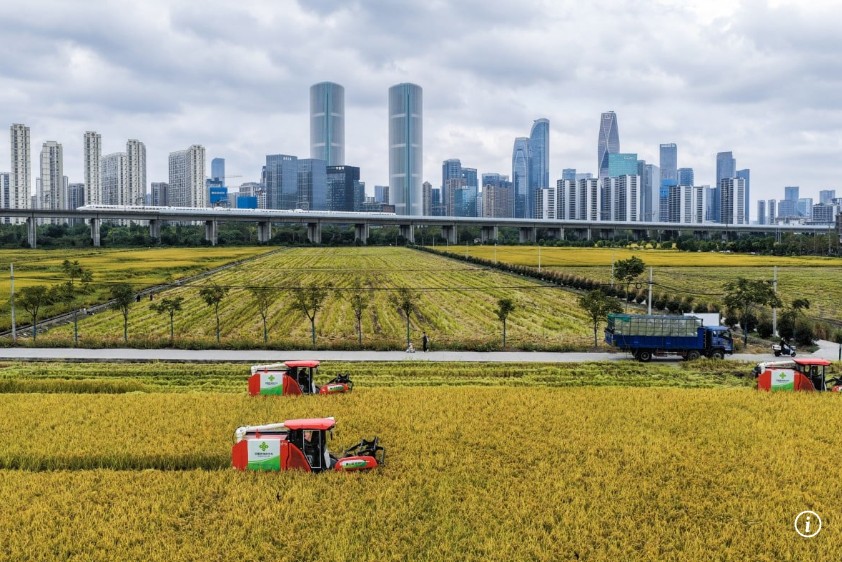
Beijing has announced ambitious plans to boost grain production to 725 million tonnes by 2030, a record high, as part of its 15th five-year plan.
This initiative prioritizes food security for China’s 1.4 billion citizens amid concerns over geopolitical instability and supply chain disruptions. The plan emphasizes the use of advanced agricultural technology and machinery to achieve this goal. Grain output is a “binding target,” reflecting the government’s commitment to self-sufficiency. Actual grain output exceeded 700 million tonnes in 2024, surpassing the previous plan’s target of 650 million tonnes.
Minister of Agriculture and Rural Affairs Han Jun highlighted the increasing role of smart technology in modernizing Chinese agriculture.
The latest target was unveiled during the annual meetings of China’s top legislature and advisory body amid renewed concerns over fertiliser security as tensions escalate around the Strait of Hormuz, a narrow passage connecting the Persian Gulf to the Gulf of Oman along Iran’s southern coast.
The US-Israeli war with Iran has strained supplies of sulphur and urea – crucial inputs for the spring planting season in the world’s second-largest economy.
The protracted US-China trade war has also deepened Beijing’s concerns about relying too heavily on imported crops such as soybeans.
The new five-year plan called for accelerated adoption of high-end agricultural machinery, expanded research and wider deployment of advanced farming equipment.
China’s mechanisation rate for crop cultivation, planting and harvesting has already reached 76.7 per cent, exceeding the previous five-year target of 75 per cent.
Authorities also pledged to speed up the breeding and roll-out of breakthrough crop varieties and to harness artificial intelligence to further modernise farming.
In Monday’s interview, Han said China was using more than 300,000 agricultural drones – the most in the world – and was beginning to deploy intelligent harvesting robots, smart irrigation systems and AI-powered laser-weeding robots.
Since launching a seed-industry-revitalisation campaign in 2021, Beijing has achieved breeding self-sufficiency in vegetables, livestock, poultry and aquatic products, while developing higher-yield and higher-quality varieties, he added.
The next phase would accelerate a new round of variety upgrades, he said.
Under the new blueprint, Beijing said it would step up efforts to boost yields for major grain and oil crops, strengthen soybean production capacity and maintain stable planting areas. It would also expand production of beef and dairy cattle, aquaculture and marine fisheries as part of efforts to build a more diversified food supply system.
Authorities pledged to stabilise prices and secure supplies for critical fertiliser products while bolstering the national reserve system.

