

A baseball team for children with autism, a program developed by a professor from the Department of Kinesiology at Mayaguez University Campus (RUM), from the University of Puerto Rico, It will debut in a friendly match this Monday in the El Seco neighborhood from 6:00 in the afternoon.
The meeting, following the model of inclusivity through sport, will be held against children from the regular stream, from another of the children’s sports programs that the teacher Dr. Christian Martinez Rivera has been implemented in the same low-income community in the town of Mayaguez.
“At least until 2026, to our knowledge, there were no teams for children with autism. And since there are no teams here, we contacted an association in the United States, called Alternative Baseball (ABO)“, he explained in an interview with The New Day the professor from Mayaguez, who has a doctorate in Kinesiology with specialties in Adapted Physical Education and in Physical Activity and Health Promotion.
With the help of Physical Education students from RUM, the program will provide an opportunity for leisure and entertainment, and above all physical activity for children on the autism spectrum.
The initial contact with the ABO was to learn about the implementation of the program, which in the United States focuses on young people aged 15 and older, and which, due to its larger population, has multiple teams in various states and cities of the North American nation.
“In the case of Puerto Rico, since there were teams, I have children from six years old to 15 and 16.”
Martinez Rivera clarified that the disparity in ages of children of both sexes, participating together on the same team, does not represent a problem, since baseball activity does not emphasize the competitive aspect, but rather on learning fundamentals. In that sense, he clarified that it is adapted baseball.
Therefore, the opening match that will be held this Monday is scheduled as an opportunity for the exercise of children and young people with special conditions, such as autism.
“The idea is that eventually we can play with them. For example, the opening on Monday is against a regular baseball team, but of younger children, from 3 to 11 years old. What we do is we bring a third team to help children with autism,” specified the professor who graduated as a RUM student, and who returned to the island a few years ago after completing his graduate studies in the United States and working abroad.
“It is a model from the United States called ‘peer coaching’, in which The child who knows how to play baseball helps the child with autism who does not know how to play or who finds it difficult. It tells him where he is going to run, how to hit.”
The doctor in Kinesiology said that the philosophy of this model is to provide a safe space for physical activity for children with autism, with them being the main protagonists of the event, but at the same time teaching the regular children who participate with them, to be empathetic and recognize that in their environment there are peers with a variety of situations and conditions.
“It helps children who are more competitive to be aware that the world is different, that there are children who “They do not necessarily need to compete, but rather areas to promote physical activity and sports.”he clarified.
Martinez Rivera indicated that at the moment the baseball program has children with level 1 and level 2 autism.
“At the Colegio de Mayaguez we have a curricular sequence in Adapted Physical Education, and so what we do is that our students, if the child has a higher level of autism, then we put them one by one,” he said.
“Now since there are no classes, we are not going to have children with more severe autism, but when the semester begins with the Adapted Physical Education class, which is the one I teach, they go to the communities and include children with severe conditions, with cerebral palsy… different conditions.”
Discrimination as the genesis of the program
Martinez Rivera said that his expectation, and that of the non-profit organization he contacted for guidance, the ABO, is that this type of baseball program for children with autism extends to the entire island.
Martinez Rivera pointed out that a key element in the equation is recruiting Physical Education teachers around the country who want to join the initiative.
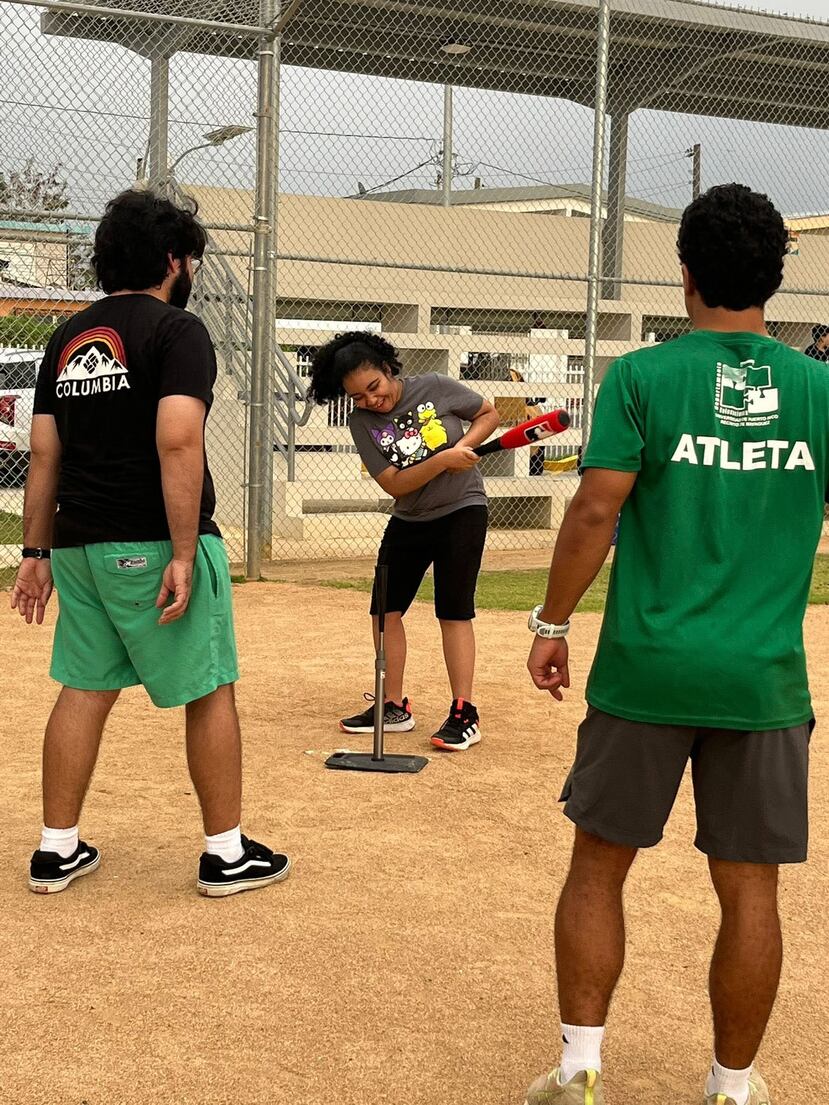
“I do different research projects in schools. I have one on childhood obesity. This is just one of the six or seven that I have right now at the university. For example, this one comes from research that we did with these children, on physical activity, where parents, mostly single mothers, told us that in Mayaguez there were zero services for children with autism. Many had to travel to San Juan to play basketball. And when they arrived in San Juan, if the tournament was worth 25 dollars, they told them, ‘it’s worth $50,’ because I have to give you an assistant,’” he said.
Based on these findings from his research, in which he found these signs of discrimination and lack of services, he took on the task of starting the project.
Martinez Rivera credited Dr. Jennifer Cruz Bracero, pediatrician, the RUM Kinesiology Department and its director Dr. Eduardo Soltero, and Dr. Bryan Rivera, sports management specialist, for their support in developing and establishing the baseball program.
He also recognized The Ohio State University, with which the RUM partnered for this project, in particular with its professor Dr. Samuel R. Hodge, who has been traveling to the island for more than two decades and has recruited more than 10 Puerto Ricans for graduate studies with scholarships, including Martinez Rivera himself. Hodge comes to the island for this initiative on Monday.

