

Carmaker’s six vessels can carry 45,600 cars, and two more ships will add 16,200 to that total soon, company says
BYD, the world’s largest electric vehicle (EV) maker, has taken delivery of two new car-carrying ships – the largest yet in a growing fleet – as it bets on export growth to counter brutal competition at home.
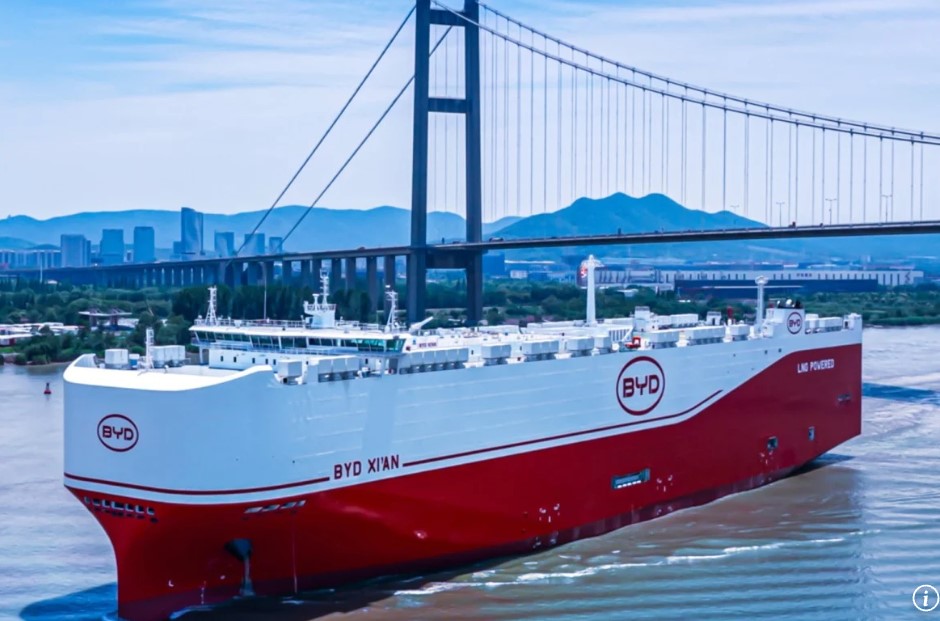
The Shenzhen-based company took delivery of its sixth carrier, the BYD Changsha, which can transport 9,200 vehicles, on Tuesday, just three days after it received the Xi’an, another vessel with the same capacity.
The company’s six roll on/roll off vessels had a combined capacity of 45,600 vehicles, and another two ships with a combined capacity of 16,200 cars were due for delivery in coming months, BYD said.
The Xi’an was put to work immediately; laden with 7,000 EVs, it set sail on Tuesday from Taicang, in eastern China’s Jiangsu province, bound for European countries including Italy, the UK, Spain and Belgium, BYD said.
“The ships reflect BYD’s resolve to achieve higher sales in markets outside mainland China, since it can enjoy a higher profit margin abroad,” said Chen Jinzhu, CEO of consultancy Shanghai Mingliang Auto Service. “With car carriers owned and operated by the company, it can quicken its export pace and save ocean transport costs.”
BYD exported 374,200 vehicles in the first five months of 2025, up 112 per cent from a year earlier. Exports accounted for 21.5 per cent of its total deliveries, compared with just 10 per cent in 2024.
As its EVs are subject to a 27 per cent tariff in the European Union, BYD’s most affordable model, the Dolphin Surf, starts at €22,990 (US$26,679) on the continent. In mainland China, the same model, known as the Seagull, starts at 69,800 yuan (US$9,726), or about 63 per cent less.
In April, BYD sold more pure EVs in Europe than market leader Tesla for the first time, buoyed by the rising popularity of its cheaper models.
The Chinese carmaker handed 7,231 battery electric cars to European customers that month, a year-on-year increase of 169 per cent, according to data gathered from 28 EU countries by research firm Jato Dynamics. Tesla’s sales nosedived by 49 per cent year on year to 7,165 units in April.
A BYD Dolphin Surf electric vehicle is displayed on stage during a presentation by BYD in Berlin, on May 21, 2025. Photo: Reuters
In the cutthroat domestic market, BYD offered discounts of 10 per cent to more than 30 per cent on 22 of its battery-powered and plug-in hybrid models starting in May, which prompted local rivals to slash prices on 70 models, according to mainland business publication 21st Century Business Herald.
Chinese carmakers offered an average discount of 16.8 per cent on their vehicles in April, up from 8.3 per cent a year earlier, JPMorgan Chase said in an April report.
Nick Lai, the firm’s head of Asia-Pacific auto research, said the price cuts would cloud the companies’ earnings outlooks as their margins declined.
BYD is not alone in christening its own ships. State-owned SAIC Motor and Chery Automobile, as well as Geely Auto, the country’s second-largest vehicle assembler, have also been aggressively building their own fleets to bolster exports. Shanghai-based SAIC, the Chinese partner of Volkswagen and General Motors, said it had 36 vessels.

