

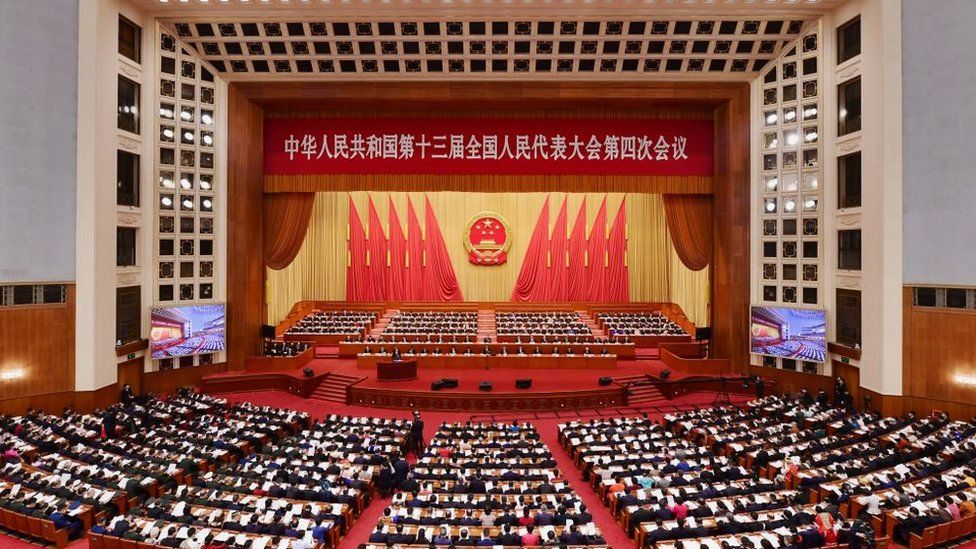
China’s Parliament has approved this Thursday the controversial electoral reform for Hong Kong, a measure with which the Government hopes to promote the ruling party in the Chinese special administrative region.
The reform of the electoral system has gone ahead with a large majority in what is already the fourth session of Parliament to deal with the matter, according to information from the Xinhua news agency.
Thus, under the new regulations, members of Parliament and of the Chinese People’s Political Consultative Conference will be able to be part of the Electoral Commission in charge of electing the next head of government in Hong Kong next year.
This is a new measure to increase the power of the central government over the region after the passage of the National Security Law in June 2020, which critics say undermines the freedoms and rights of Hong Kongers.
Hong Kong’s electoral system, which includes the method for selecting the head of government and forming the Legislative Council, is an important part of the region’s political structure, as the Asian giant’s Parliament has concluded.
For this reason, the authorities consider that such a system should be framed within the policy of ‘one country, two systems’ and ensure that Hong Kong is thus administered by “people who love their country”.
The elections, now scheduled for September, were suspended last summer on public health grounds given the coronavirus pandemic, according to Hong Kong authorities.
SUPPRESSION OF CRITICAL VOICES
The opposition, on the other hand, pointed out that this reason was nothing more than an excuse to suppress critical voices in the territory, having been decided under the National Security Law promulgated from Beijing and specifically designed to combat a dissidence that the Chinese authorities understand as artificial and fomented by foreign interests to destabilize the country.
Now, the new regulation opens the door to a new model in which candidates will have to obtain the endorsement of a committee of representatives from Beijing, which will make it very difficult for opposition politicians to enter the electoral race.
The new reform contemplates the increase by twenty of the deputies in the Legislative Council or Parliament of Hong Kong to the total of 90 but, above all, the above mentioned expansion of the Electoral Commission to 1,500 voters.
This remodeling would have a double aspect: the elimination of 117 seats usually in the hands of the opposition, and the incorporation of 300 new voters coming from the so-called Chinese People’s Political Consultative Conference, a political body which advises the Communist Party, as well as other academics and businessmen related to the institutions of the Chinese Government.

