


Education is usually perceived as a basic right that all citizens have, of all races and genders.which make up Puerto Rican society. However, historical evidence shows that The development of education in Puerto Rico has been a journey full of racial and social prejudicesand with much more historical complexity than is usually attributed to it.
A fundamental part of this complex trajectory is the historiographical evidence that shows that education in Puerto Rico was in the hands of Puerto Ricans Afro-descendants from the 18th century until the beginning of the 20th century.
According to Gerardo Alberto Hernandez Aponte, professor of history at the Rio Piedras Campus of the University of Puerto Rico (UPR), Rio Piedras Campusand author of the book “The educational and historiographic environment of Celestina Cordero Molina”educational efforts in Puerto Rico, including education for women, date back to the arrival of the colonizers.
The professor indicated that the Church and the government initiated formal education on the island, although at first only boys were educated while girls were taught Christian doctrine, embroidery and knitting, among other tasks socially established as “proper to women.”
She also noted that the vast majority of female teachers were African-descended Puerto Ricans.
“I am convinced that the majority of female teachers at that time were black. In March 1904, the mulatto teacher Feliciana Megia Baez He died in San Juan at the age of 86. The press at the time reported that many people, including pharmacists, doctors and lawyers, studied under his guidance,” said Hernandez Aponte.
“It was these black women with no education, widows or singles, who looked after the children and taught them various subjects. But it was informal teaching, because reading and writing, although it may seem strange to us today, were not considered very important,” she added.
Hernandez Aponte highlighted that since at least the 17th century, there were in Spain women who looked after the children for a few hours while their mothers performed tasksThese women were paid a modest amount of money.
Spanish historiography calls the teaching in the homes of these informal teachers by the name of “Friendly schools”.
“It all started (in Puerto Rico) with the Amiga schools because it was an institution that was transferred from Spain to all the colonies, but, since it is an informal education, there are no precise records,” Hernandez Aponte lamented.
In her book, Hernandez Aponte argues that the women who worked in this profession in Puerto Rico, and most likely in the other Spanish colonies in the Caribbean, were mostly Afro-descendants, elderly, widowed or single, and with limited education.
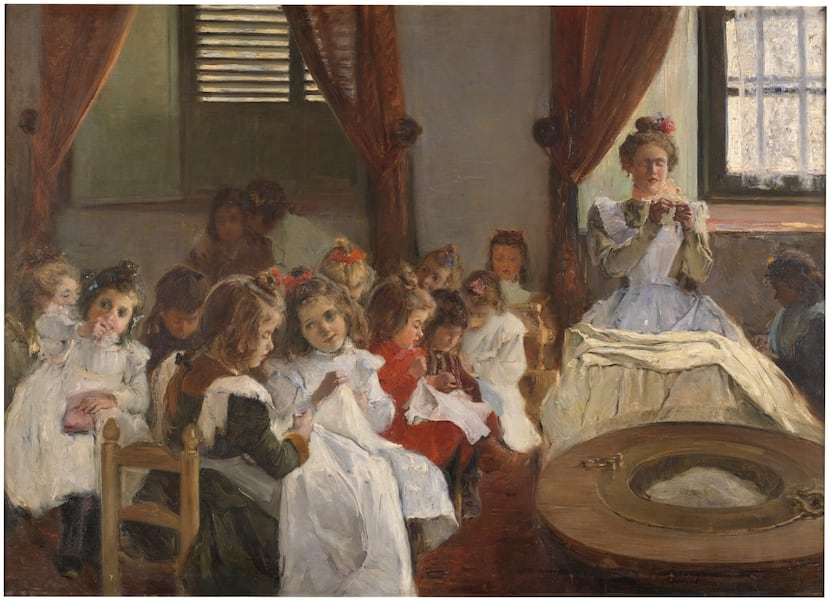
They were known as “Friend teacher” and offered lessons in their own homes.
“These schools were an informal response to the needs of the poor classes to care for and educate boys and girls,” explained the author of a detailed investigation on the teacher Rafael Cordero Molina.
“The Amiga schools fulfilled several functions. On the one hand, they helped working mothers by taking care of their children and giving them certain education, and on the other hand, they were a way for some women to survive. In some of these cases, they functioned as what we know today as daycare centers,” said Hernandez Aponte.
Many of the Puerto Rican heroes of the 19th century were educated at the primary level in this type of school. Figures such as Jose Julian Acosta y Calbo, Juan Morel Campos and Eugenio Maria de Hostos, among many others, were products of the Amiga schools.
In this context arose Celestina Cordero Molina (1787-1862)one of the emblematic figures, along with her brother Rafael, of education in Puerto Rico and, in the case of the former, of the Amiga schools on the island.
It is very likely, the historian explained, that Cordero Molina received his education directly from his parents, as was usual at the time. His mother taught him the subjects she knew, while his father taught him to write.
However, although the figure of teacher Rafael Cordero, and later that of his sister, are revered as pioneers of interracial education in Puerto Rico, the reality is that They were just two of the dozens of Afro-descendant teachers who carried on their shoulders the responsibility of educating a country.
Similarly, the racial integration of schools, Hernandez Aponte argued, was encouraged by the Cabildo (the government).
“Interracial education was promoted by the government at a historical moment when the majority of the population was not white, and even Pablo Benigno Carrion de Malaga, bishop of Puerto Ricomentions it in his writings,” he said.
“Neither Rafael nor Celestina are really pioneers of interracial education. They were very important, but there were many other teachers like Jacinta Ramirez, Santos Oxios and teacher Rafaela –who taught De Hostos,” the professor explained.
Hernandez Aponte said that the contribution of this extraordinary black woman is incalculable, as she impacted more than one generation of pupils of both sexes.
“Celestina rented a house, she did not charge any of her students, but she lived with the sewing products that her disciples produced and He taught 117 female disciples at the same time. This is an extraordinary thing in a patriarchal and racist society.”said Hernandez Aponte.
“In addition to that, he had to support his mother, who was elderly, his sister Gregoria, who was also a teacher and was ill, and Rafael himself, who had not yet dedicated himself to teaching, because Celestina was older than him,” he said.
The lack of documentation on these informal schools does not allow us to know exactly where they were located, although the professor assured that Celestina’s school could have been located on the islet of San Juan.
When we think of public education, we probably think of a system in which the government provides free education to citizens through schools spread across the country. However, this concept, which dates back to the 18th and 19th centuries, the professor explained, is far from what it is today.
“The public schools of that time are not the public schools of today. One had to pay for public education, although it was still in the teachers’ homes. It was called ‘public’ because it was administered by the government,” explained Hernandez Aponte, who added that, unlike the Amiga schools, these “public” schools were authorized by the government.
According to Hernandez Aponte, in that teaching system, the male teacher received two salaries: the one granted by the Council and an additional fee. However, If the Council could not assume the salary because it did not have “own funds,” as was usual, the amount was prorated among the school’s residents.
“In other words, residents had to pay a fee for their children to study in public schools,” explained the professor, who pointed out that in the case of female teachers, this fee was not granted.
“Female teachers, on the other hand, received a fixed salary that was already stipulated and was lower than that of male teachers.”the professor added.
However, Hernandez Aponte maintained that there was no racial segregation in these schools as has been speculated, although he acknowledged that segregated schools did exist, and that there were isolated attempts to establish racial segregation in education.
However, the professor stressed that these attempts were unsuccessful because, since 1770, there was a regulation, established by the then governor and captain general of Puerto Rico, Miguel de Muesas, which stipulated that every teacher had to accept every child, regardless of the color of their skin.
“The problem was that, By the late 18th century, more than 60% of the island’s population was non-white. “So, if there are no pure whites, as stipulated by Spain’s blood purity laws, who would be a priest, or a soldier, or a civil servant…?” Hernandez Aponte questioned.

