


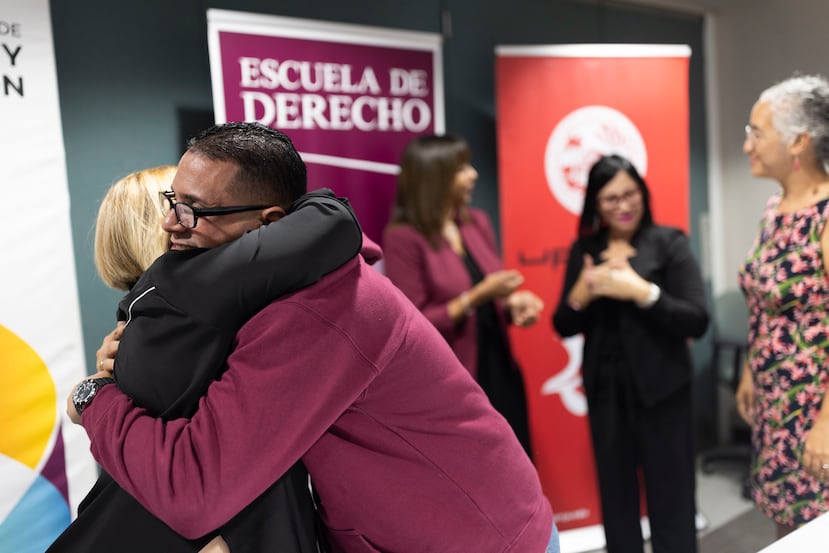
Wearing the wine-colored coat of the Law School of the University of Puerto Rico (UPR) –given to him by his classmates–, Miguel Angel Nieves Dominguez He left the classroom on Tuesday excited to share how his life has changed since he began to feed his need for justice with education from the first educational center in the country.
“I see myself working for communities that are marginalized. I come from suffering and I am a product of the consequences of the law. I am on my way to provoke changes, to be a model so that those who are watching behind, who are walking where we are removing the obstacles, can (study). Here, what is needed is will.“, emphasized the 44-year-old student, who began his graduate studies just over a month ago.
Nieves Dominguez is the first inmate to be admitted to a law school in Puerto Rico, as part of an agreement between the UPR and the Department of Correction and Rehabilitation (DCR) to offer this opportunity to persons deprived of their liberty with a tuition waiver.
“This is more than just historical; it is what needs to be done. Education is the key to social transformation. If it has served me well, why can it not serve others?“, emphasized the father of two young people, aged 17 and 20.
In 2011, Nieves Dominguez received a 105-year sentence on charges related to a murder committed in Puerto Nuevo in 2009. Although she did not go into details of the crimes she committed, she insisted that university education serves to achieve a “change of worldview” and to help young people make better decisions and have real opportunities for development.
She said she decided to study law because “I have always been a good activist.” “I started to advise the boys (in prison) who did not know how to make a motion. Sometimes, I gave workshops because I could not find anyone. Even though I was studying and had time to spare, I said that I had to teach. It gave me that hunger to be (defending) wherever there was a violation of rights, something contrary to the law that some human being suffers.”he pointed out.
She said she decided to study law because “I have always been a good activist.” “I started to advise the boys (in prison) who did not know how to make a motion. Sometimes, I gave workshops because I could not find anyone. Even though I was studying and had time to spare, I said that I had to teach. It gave me that hunger to be (defending) wherever there was a violation of rights, something contrary to the law that some human being suffers.”he pointed out.
“The weight I carry”
At the same time, he insisted that his fellow inmates, who already call him “Licenciado,” know “the weight I carry.” “They give me my space, they let me study, they help me with anything, like (turning down) the noise. The officers have also helped me a lot,” said the inmate, who was also admitted, in January, to the Master’s degree in Administration and Cultural Management at the Faculty of Humanities.
His routine begins at 5:00 am, when he gets up to start reading and prepare to leave prison to go to his school. He arrives with custody at Rio Piedras Campusand there he continues reading cases and laws while waiting for his classes.
“There are no days off to be able to complete this (his degree). I have a very big challenge. Here there are groups that form study groups, there are talks and workshops constantly, which I would like to attend a lot, but I cannot participate in everything I would like to.“, commented the graduate of a Bachelor of Fine Arts from the General Studies program.
After actively participating in her Family Law class, Nieves Dominguez shared that her interest, beyond maximizing her knowledge on various legal topics, is based on “contributing my grain of sand to social change, to work with social problems.”
The professor Erika Fontanez Torreswith 21 years of experience at the UPR, has known Nieves Dominguez since high school, when she offered him the Theory of Law course in prison.Miguel has exceptional skills. It is not that we are going to transform him here, but he already comes with life experiences that allow us to delve deeper into the Law. On many occasions, the people who suffer the laws, the codes, the prison, are absent from the discussion, but he is here and allows us to delve deeper into the legal analysis.“said the teacher.
“We believe in him”
Marina Rodrigueza first-year classmate, acknowledged Nieves Dominguez’s contributions and “enthusiasm (for collaborating and changing the system).His perspective is one of the most important because he is someone who lives in the prison system and knows everything that is faced there. We are excited that incarcerated people participate in our classes, because they have the right and we see that impetus for change. We believe in him and in giving second chances.“, he noted.
At the same time, the professor Edna Benitez Labordecoordinator of the University Studies Program for Confined Persons, committed herself to Nieves Dominguez to advocate for that he “leave the penal institution under some type of executive clemency”In 2034, the minimum of his sentence will be served.
“I think it is important, in order to complete his law studies and to be able to fight the other battles that await him on the way, that he be outside the correctional context in order to fully develop his abilities and his legal training. I cannot guarantee the results because they are not in my hands, but the battle will take place,” he stressed.
Nieves Dominguez took the standardized test designed for admission to law school (LSAT) in February, after studying “non-stop” for three months.
“I waited (for the results) until summer, when I found out that I had gotten the third highest mark. (…) Everyone was betting on me. They told me: ‘Come on, you’re going to pass’. Frankly, I found it extremely difficult and I thought I wouldn’t be able to do it.”he said excitedly.
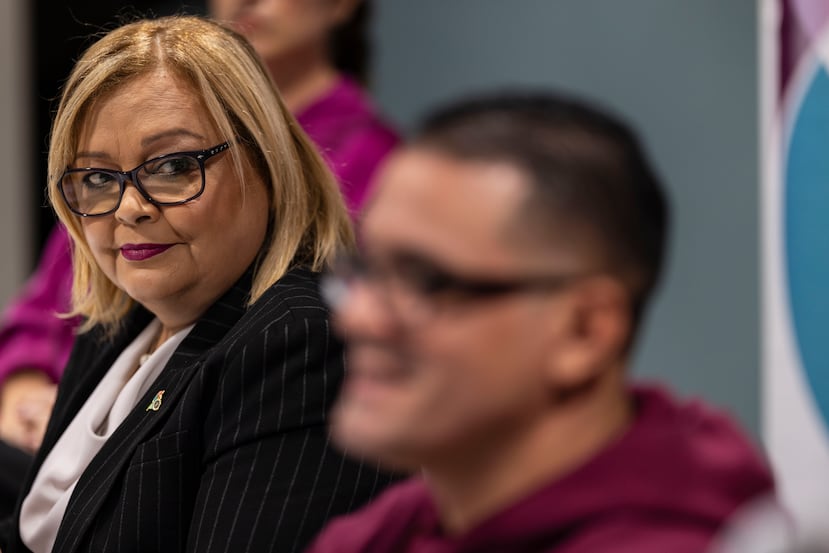
Of all the educational institutions approved by the American Bar Association“We are the only one with an in-person program for people deprived of their liberty,” said the dean of the UPR School of Law, Vivian Neptune.
He explained that, following the model of bachelor’s and master’s studies, a tuition waiver was approved by the president and the UPR Governing Board“It opens the door for other students to also prepare, take the entrance exam and study. It is not only for Miguel, but it includes up to three students who have expressed interest in studying Law,” the dean responded about how these studies are funded.
DCR Secretary, Ana Escobar Pabonindicated that on October 5 they renewed the agreement with the UPR, which will be valid until July 2029 and includes two admissions for August 2025 and 2026.
“I hope that in the future, when I am no longer leading the DRC, my successors will evaluate all the progress and continue to firmly believe in the rehabilitation processes and that education is one of the proven real alternatives that can allow for such reintegration and transformation in members of the correctional population.”he said.
“In the context of maximum custody, I was blocked and confused. Once I started university, my perspective of the world began to change. I was taught to put ideas and feelings into words, to channel emotions… The development I have had has been enormous,” acknowledged Nieves Dominguez, who has been in minimum custody since December 27.

