

The walls of La Guaira they became a huge billboard of missing people. Where there used to be commercial advertisements or political propaganda, today dozens of A4 sheets protected with adhesive tape hang. There are passport photographs, family portraits, names written in black marker and telephone numbers for anyone who can provide a clue. Some leaves are already beginning to peel off due to the humidity of the Caribbean. Others were hit just a few hours before. None promise a reward. They all look for exactly the same thing: a person who has not yet appeared.
Eleven days after the earthquake, the coast of La Guaira remains immersed in a routine that seems to have no rest. From the highway to the sea, the military checkpoints happen every few kilometers. Soldiers check vehicles, regulate entry and guard the most affected areas. Their presence, however, also generates discomfort among part of the population. Many Venezuelans questioned the role of the security forces and they maintained that the controls hinder the entry of aid and slow down the work of those trying to reach the collapsed buildings.
In recent days, videos have also circulated on social networks showing soldiers remaining as spectators while civilians participate in the search tasks.
The walls of La Guaira were covered with photos and names in a desperate search for the missing
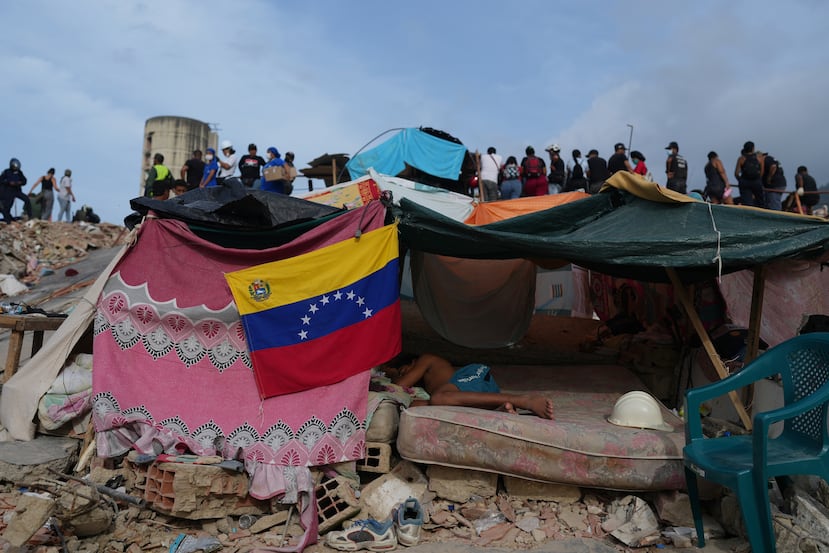
As you approach the coast, the same postcard appears: open buildings, balconies suspended in the air and concrete mountains that still hide unresolved duels.
The uncertainty also fueled other fears. Neighbors and volunteers say that some people take advantage of the chaos to enter collapsed buildings in search of moneyjewelry or other valuable objects that were left among the destroyed apartments. They are stories that are repeated in different neighborhoods and that explain, in part, the concern of many families to remain next to the ruins of their homes even when rescue efforts last for days.
1/11 | In images: the desperate journey of relatives in search of their loved ones in hospitals in Venezuela. Thousands of people are looking for one or more family members in the midst of anguish. Photos of children, elderly people, couples, along with their names and description, as well as a telephone number to receive information, flood the walls of the hospitals. – Raul Martinez
“I was already looted”
Throughout the day, LA NACION toured Caraballeda, Caribe and Playa Lido. As the kilometers progress, the dimension of the disaster is no longer measured by the number of fallen buildings. It is measured by continuity, because a neighborhood of towers did not simply fall…There are kilometers of coast where the landscape seems to have been pulverized and strangled by the fury of nature..
The emergency also left sad and “ironic” marks. In several businesses, especially supermarkets, the owners wrote a short phrase directly on the blinds or walls to avoid unnecessary questions: “I was already looted”.
There are hotels with rooms open to the vacuum. Buildings where curtains still hang that move with the sea breeze. There is an armchair that remains exactly where someone left it minutes before the earth began to shake on June 24. The The privacy of thousands of families was exposed as if the facades had disappeared in one fell swoop.
The search doesn’t stop either. Colonel Miguel Angel Wissinger, head of the Argentine contingent deployed in Venezuela, explains to LA NACION that the mission changed stages. “Right now we are in phase number two”account. “We are supporting all the mechanical teams and road machines. Our job is to help them if they find a living person or a corpse that must be handed over to the Venezuelan authorities”.
The Argentine contingent, located in Playa Lido, on a synthetic grass soccer field overlooking the sea, brings together approximately 80 members of the Navy, Army and Air Force. There are also doctors, nurses, psychologists and surgeons. They also prepare special rations for heavy machinery operators. “Today, in particular, there would apparently be life in one of the places where we are working”says the colonel.
Families wait and wait. That caution also reflects a dilemma that is repeated around each collapsed building. Among those waiting behind the security tapes two different emergencies coexist. The Relatives seeking to recover the body of a loved one often ask that machines speed up the work. Those who still hope to find someone alive prefer the opposite.: that each slab moves as gently as possible. They know that a hasty maneuver can turn a rescue into an irreversible tragedy. Days ago, during one of the removal tasks, a machine accidentally dismembered a body trapped in the rubble..
Mothers, brothers, neighbors and friends are waiting. They wait in front of the security tapes or next to the machines. Some collaborate by removing debris. Others simply observe the work of the rescuers, but they always help, each one with what they can and know. Almost everyone repeats the same idea: they do not plan to leave until they find their relatives.
The answer comes from a larger network
One of the family members, Yaneth Perez, summarizes that feeling with a claim. “We have received help from Mexican, Cuban and Salvadoran rescuers. We have knocked on the door of the authorities to send us the necessary machinery, but they only sent us one and we need more help“, says.
Much of this aid also circulates through channels outside the State. Luis Palacios, a lawyer who spends his free time coordinating donations for churches, maintains that the answer comes from a much broader network. “We cannot continue understanding that the State is the only actor”he states. “There are churches, universities, unions, academies, organized civil society, which turn crises into positive action. In two days we have mobilized 35,000 kilos of supplies,” he says. Then he adds a reflection that also explains journalistic work in a country where official information is usually scarce: “The information is collected on the street, because the State does not have it or does not make it public”.
Argentine aid also appears among this assistance network. In addition to the official contingent of the Armed Forces, the Solidaire organizationdriven by Enrique Pineyroset up a air bridge to transfer from Ezeizaaboard its Boeing 787 Dreamliner, to rescuers from CEPA, Fenix United and ASOMEVENAR. Since then, the plane makes round-trip flights to Panama, where it loads medicines, food and other supplies before returning to Venezuela. During the tour of the affected area, several volunteers spontaneously mentioned Pineyro and thanked him for his support. Although many inhabitants of La Guaira do not know the origin of this assistance, among those who participate in the humanitarian response his name frequently circulates as one of the promoters of international aid.
As the afternoon falls, the photos of the missing are still stuck to the walls. The excavators continue lifting slabs as the sun goes down. Nobody seems willing to leave their place.
Before saying goodbye, a Venezuelan observes the landscape of open buildings, dust and cranes. He pauses and tells me: “I’m sorry that you’re getting to know Venezuela under these circumstances. It’s a beautiful country, but it’s turned into shit.” There was no need to add anything else.
