

Tehran— Hundreds of thousands of mourners began the multi-day funeral of Iran’s supreme leader in Tehran on Saturday. Iranhe Ayatollah Ali Khameneibeating his chest in pain before the glass urn that contains his coffin, covered with a flag, and asking for revenge against Israel and the United States.
The funeral of Khamenei, who ruled Iran for decades before dying at age 86 in an airstrike on February 28, in the early stages of the iran warcould give a boost to the country’s theocracy and its son and new supreme leader, Ayatollah Moytaba Khamenei.
This is especially important as Iran seeks to leverage its control over the Strait of Hormuz in negotiations with the United States to permanently end the war, and as concerns remain that Israel may strike again. The funeral was delayed as the war escalated, and talks appear to be on hold until the war ends.
During the ceremony, Iran’s chief negotiator issued a warning to France and to United Kingdom for his comments on the possibility of sending joint patrols in the waterway, the strait at the mouth of the Persian Gulf through which, in peacetime, a fifth of all oil and natural gas used to pass.
Mourners cried when they saw Khamenei’s coffin next to those of his relatives, who also died in the airstrike, and some chanted: “Our word is one! Revenge! Revenge!”. Some carried banners and flags, and billboards with Khamenei’s image could be seen in various parts of the city. Crowds of men beat their chests rhythmically in mourning, a common practice at Shiite funerals.
“Imam Khamenei was our heart, our father, our everything,” said Masoumeh Mohammadi. “I still can’t believe they martyred him. We will not rest until we avenge his death.”
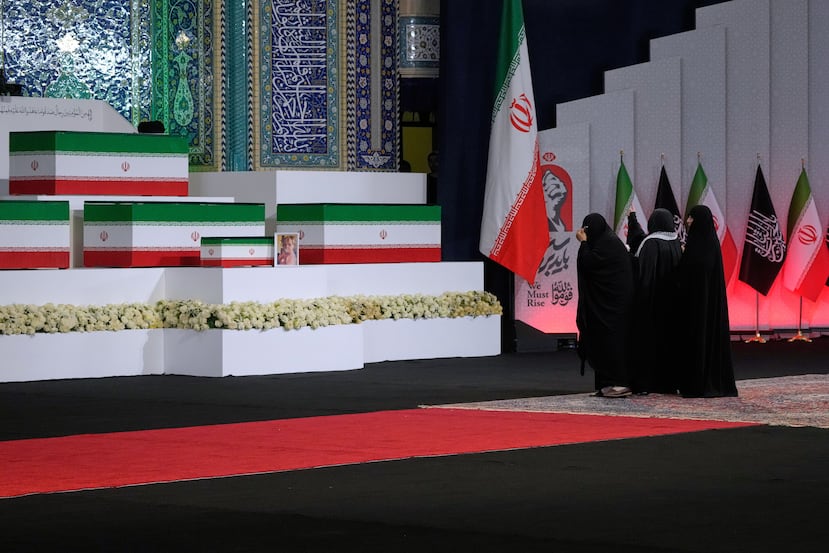
Coffins displayed in the Great Mosque of Mosalla
An open-air stage set up at the Grand Mosque of Mosalla resembled the dais from which Khamenei used to deliver his speeches at a husainia, inside his complex in central Tehran. A chair like the one he used to sit in when he gave his sermons, with a microphone on a stand and a small table next to it. Just above it hung an image of the late supreme leader, Ayatollah Ruhollah Khomeini, who died in 1989.
Khomeini’s funeral was marked by chaotic scenes, as millions of people thronged the funeral ceremony and the journey to the cemetery. Khamenei’s death, only the second time Iran has lost a supreme leader since the Islamic Revolution of 1979took place in February and gave authorities more time to prepare.
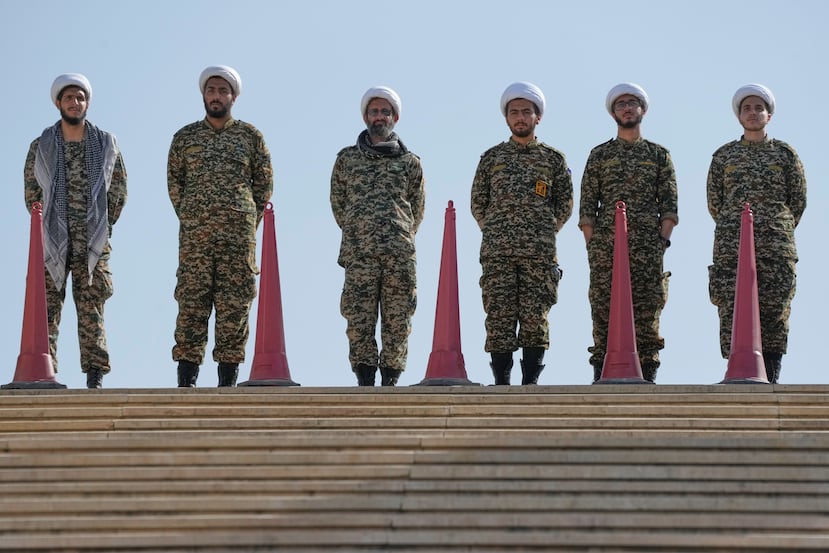
On Saturday, volunteers sprayed water to cool the crowd in the heat of summer, and food and drink were offered at outdoor stalls. Men and women gathered separately inside the Great Mosque of Mosalla after being subjected to metal detector checks and body searches. Police armed with assault rifles stood guard on the surrounding streets. Many stayed outside, on the street, resting in the shade of the trees, since the city had closed.
The coffins of the deceased Ayatollah’s relatives were placed beneath his, on which rested his black turban, identifying him as a direct descendant of the Prophet Muhammad. Among the deceased is Moytaba Khamenei’s wife, whose possible presence at the funeral remained unclear. According to some reports, he was injured in the attack that killed his father and has not been seen in public since the war broke out.
“We attended the funeral to show that we are all committed to defending our country and our religion,” declared Ali Kazemi.
As dusk approached, people continued to arrive.
“The authorities advised not to rush to the places,” said another visitor, Mohammad Barati. Mourners were also advised not to stay too long to allow other people to enter.
Just as the United States celebrates its 250th anniversary
Iran chose July 4, the same day the United States celebrates 250 years of its founding, to begin the funeral. Although the authorities did not recognize the coincidence, the crowd present at the Tehran ceremony chanted: “Death to America!”taking up a cry that has been common in Iran since the Islamic Revolution of 1979, the seizure of the American embassy and the hostage crisis. They also shouted: “Death to Israel!”.
“We have given Iran a tremendous beating,” declared the US president donald trump in a speech delivered at the same time in South Dakotain front of Mount Rushmore. “They are desperate to reach an agreement. We have given them a week off for a funeral.”
The American president did not go unnoticed in Tehran. Among the crowd gathered at the Great Mosque of Mosalla, several mourners held a large flag that read: “#KillTrump.”
As the ceremony progressed, Iran’s chief negotiator, Kazem Gharibabadi, criticized a joint statement issued overnight by British Prime Minister Keir Starmer and French President Emmanuel Macron suggesting their armed forces were prepared to patrol the Strait of Hormuz.
Iran has expressed its intention to charge ships that pass through it, marking a radical change from the decades in which the world has considered it an international waterway.
“The security of the Strait of Hormuz is the responsibility of coastal states; those responsible for the crisis will be held accountable for the consequences of their adventurism,” Gharibabadi wrote in X. “This is a serious warning.”
He will be buried in Mashhad
Khamenei’s body will be transferred to several cities in Iran and neighboring Iraq. Authorities have closed streets and airspace and disrupted daily life due to mourning, which will end on Thursday when he is buried at the Imam Reza shrine in Mashhad, Khamenei’s birthplace.
Authorities did not immediately provide the number of attendees at Saturday’s event. Other cities in Iran also held mourning ceremonies.
A prayer for the deceased is planned for Sunday at the Great Mosque of Mosalla. On Monday, Khamenei’s coffin and those of his relatives will be carried through the streets of Tehran, likely drawing large crowds.
“I am here to say goodbye to my beloved leader Ali Khamenei,” declared Hananeh Mousavi, 27, who attended the funeral with her mother in tears. “I never thought a day like this would come. I wish I had died before this tragedy.”

