


The song begins like a thunderclap. From a dark nothingness, a brilliant light is born, filling the space and forcing all souls to unite in its sonority. One voice suddenly transforms into many, and the sound takes the form of a verse. And even though the song has been heard everywhere without ceasing for three days, there is something in its verses, in its very melody, that makes it impossible to tire of it. This morning, in the heart of Moca, all of Puerto Rico sings and “Verde Luz” takes over everything.
There have been many tributes since the announcement of his death. The mortal remains of Antonio Caban Vale, “The Mole”have received, in three days, the treatment reserved for a legend like few others. But this Wednesday, the tribute comes to an end. These have been long days for his family. After an initial stop in San Juan, the last will be this one, as he wanted: Mocano until the end.
Hundreds of people have arrived at the Dr. Juan Sanchez Acevedo Coliseum to pay their last respects to the singer. The large field has been transformed, for today, into a large chapel, where a sacrifice will be celebrated in the name of his memory and eternal rest. From the entrance, the music of “El Topo” serves as an obvious soundtrack to the place. Several images of the singer welcome visitors, along with a small podium on which they can sign their names and take a card with a photo and verses from the singer as a souvenir.
A large Puerto Rican flag covers half of the field, almost completely covering the stands. In front of the improvised altar, rest the remains of the small man who became a giant.
The service, as expected, is lengthy. Several artists offer brief messages and condolences. Figures such as Carmen Nydia Velazquez, Carlos Esteban Fonseca and Chabela Rodriguez offer a few words. Others, although they could not attend in person, send their words, either through writings, or voice messages, as Danny Rivera and the Cuban Silvio RodriguezTheir words, though different, contain the same spirit of lamentation and sadness, and in the end, all their voices join in a single cry, the cry of a country that loves its son.
The mass could well be like any other. Reading, psalm, word, homily, Eucharist and farewell. But when it comes to “El Topo”, divine grace decides to have something special in store for him. The songs in the middle of the ceremony are led by the voices of Andres Jimenez and Roy Brown, disciples, friends and colleagues.
“On wings of splendor,
singing a song.”
This is how “El Jibaro” sings to the poet, saying goodbye with sadness, while Brown, in his turn, sings those words written by Corretjer, which describe life as a great mystery that must be discovered every day, little by little.
what time undoes.
Man knows where he is born
and not where he is going to die.”
As expected, during the ceremony, there was no shortage of calls for patriotic love, sacrifice and work in imitation of the great man who has passed away.
“Someone should stand up, someone should show their face. That’s what the country needs. El Topo did it, and sinking his life and roots into the land where he was born, Moca, he re-emerges to continue speaking to Puerto Rico and saying, with guitar in hand, ‘we have to be where we have to be: in the struggle of every day.“, says the father Pedro Ortiz during his homily, and his call is met with applause.
There is only one thing left. A final walk through his town. The coffin, covered by the monoestrellada, is carried to the hearse by a group of uniformed nationalists, who have stood guard at his side since the beginning of the ceremony. Once mounted, the remains of Antonio Caban Vale begin their final journey. A large caravan accompanies him through the town of Moca to the cemetery where he will rest.
Behind the car, walking on foot under a raging sun, his son, Adean, accompanies him. Upon arrival, a few final words are offered that attempt to refresh what has already been said. That he was a great man, that he was a great musician, that he loved his country, that we must thank him. Truths that will make his memory eternal, beautiful and worthy of celebration. “El Topo” will not be buried, the voices say, no. Their remains will be planted, like a seed, so that the most important medicine their country needs may sprout from them: hope.
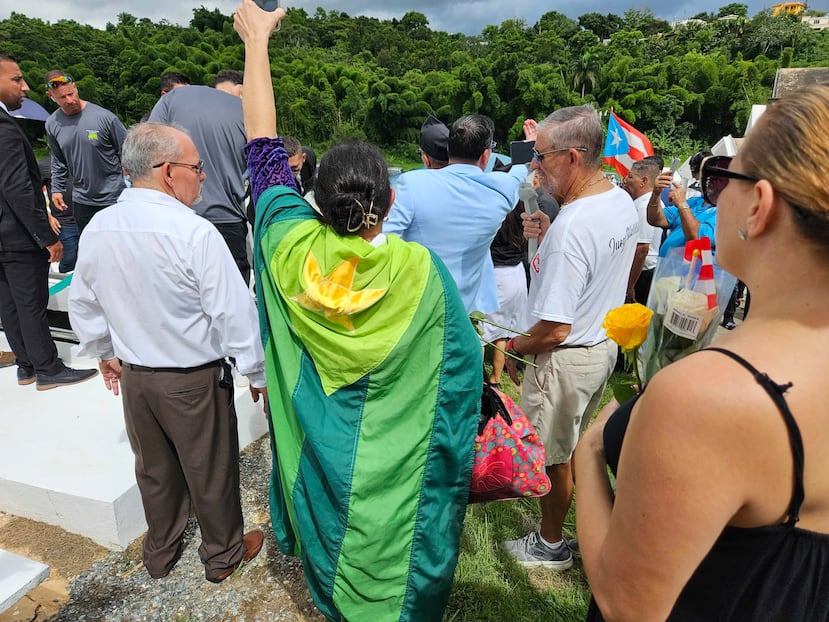
For the last time, all the voices join in song, and the verses seem to take on a life of their own.
It starts off softly, as if waiting for some permission, as if grief were drowning them.
“If I move away from your noisy beaches.
If I am absent from your silent palms,
I want to go back, I want to go back…”
The songs are filled with tears, but a courage takes hold of the melody. The voices grow, the verses transform into power.
“To feel the warm sand,
The voices fade away, pain has taken over them again, and the end, between broken voices, sounds like the saddest lament ever heard.
Once again, the group of nationalists carries the coffin. The cemetery is covered in a special greenery. As if they had prepared for this very moment. As the coffin descends, Adeanshe sings to her father, her voice as clear and melodious as that of the man who gave her life.
“Show with your hands what you feel,
let it out, let it out.
Express your affection tenderly
let it out, let it out.
Adean continues repeating the last stanza, as if prolonging this moment as much as he can. His sisters, Guaniana and Guanani They watch the moment through tears, knowing that the end has come. But as soon as the body is planted, hope begins to blossom.
Tambourines resound in the air and sadness becomes celebration. The sky begins to cloud over and drops of rain begin to fall, as if giving their water to the seed that the land of Moca has just embraced. And just steps from his grave, three silent palms rest on the edge of a ravine. “El Topo” will never be far from them. Divine grace seems to have given him one more gift.

