


“Ready! Ready, Dad, ready!” exclaims Eliezer Lopez. He throws his arms to the sky and makes the sign of the cross. Lopez’s joy spreads to his friends, who come out from tents made of plastic and boards to celebrate.
Lopez, a 20-year-old Venezuelan migrant who is currently in Mexico Cityhad reason to be happy: after several failed attempts, he was able to get an appointment to apply for asylum in USA.
He is one of thousands of migrants whose journey toward the United States has taken them to the Mexican capital, the southernmost point until recently from which migrants can register for an appointment to request asylum through the Customs and Border Protection Office’s mobile app. (CBP) known as CBP One.
Since June, when the government of President Joe Biden announced significant restrictions on migrants seeking asylum, the app became one of the only ways to apply for asylum on the southwestern border of the United States.
This US asylum policy and its geographic limits are part of the factors that have driven the appearance of improvised migrant camps in the Mexican capital, where thousands of people wait for weeks, even months, in limbo, living in overcrowded conditions, with poor hygiene services and terrible conditions.
Mexico City, from transit point to temporary stay
Historically, Mexico City has not been a common stop for migrants heading north. They try to cross the country as quickly as possible until they reach the border with the United States.But delays in getting an appointment to apply for asylum, coupled with the danger of cartel-controlled northern border towns and increased repression by Mexican authorities against migrants, have turned Mexico’s capital into a temporary destination for thousands of people.
Some migrant camps have been dismantled by immigration authorities or abandoned over time. Others remain, like the one Lopez has been living in for the past few months.
Like Lopez, many migrants have chosen to wait for an appointment in the relative safety of the capital. But in Mexico City they face other difficulties.
Space in migrant shelters is limited and, unlike in large US cities such as Chicago and New York —who last winter scrambled to find accommodation for arriving migrants—are largely left to their own devices in Mexico City.
Andrew Bahena, coordinator of the Coalition for Human Rights of Immigrants (CHIRLA) explained that Until the end of 2023, most migrants remained stranded in the southern city of Tapachula, on the border with Guatemala. Many were trying to hide their location to get around the geographic limitations of the CBP One app. But when U.S. authorities caught on, many of the migrants began looking to Mexico City as a destination to make their appointments from there, he said.
As a result, there has been an increase in the migrant population in the camps in Mexico City.
“We talk about this as border outsourcing and it is something that the United States and Mexico have been implementing jointly for years,” Bahena said of the two countries’ strategy to virtually extend the border to points further south. “The CBP One app is probably one of the best examples of that today.”
“These people are asylum seekers, they are not homeless people living in Mexico,” he added.
A swarm of tents and tarps
When Lopez arrived in Mexico City in late April, he considered renting a room, but the price made him realize that wasn’t an option.
Lopez, who worked three days a week at a street market, earned 450 Mexican pesos a day (about $23). He was asked for 3,000 pesos ($157) per person for a room shared with strangers, an arrangement that has become common in Mexican cities with migrant populations.
“The camp is a refuge,” Lopez said. Migrants can share the space with people they know, avoid curfews and strict shelter rules. They can also extend their stay if necessary.
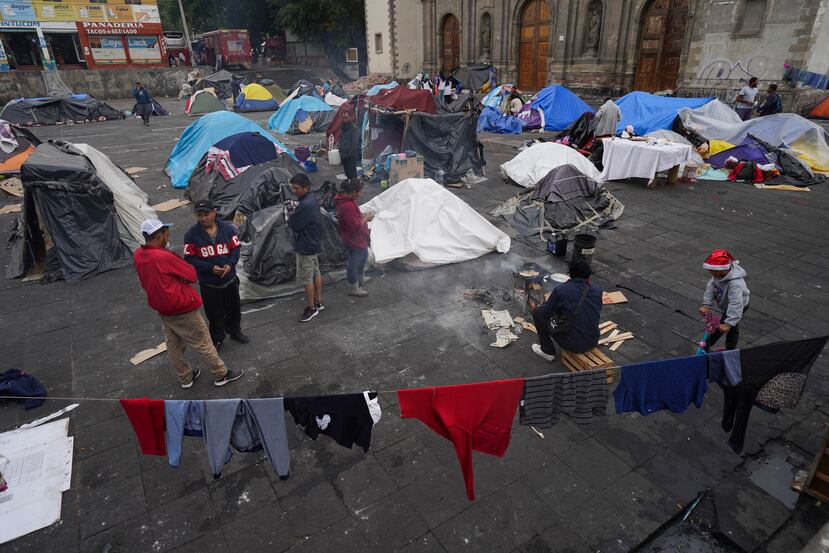
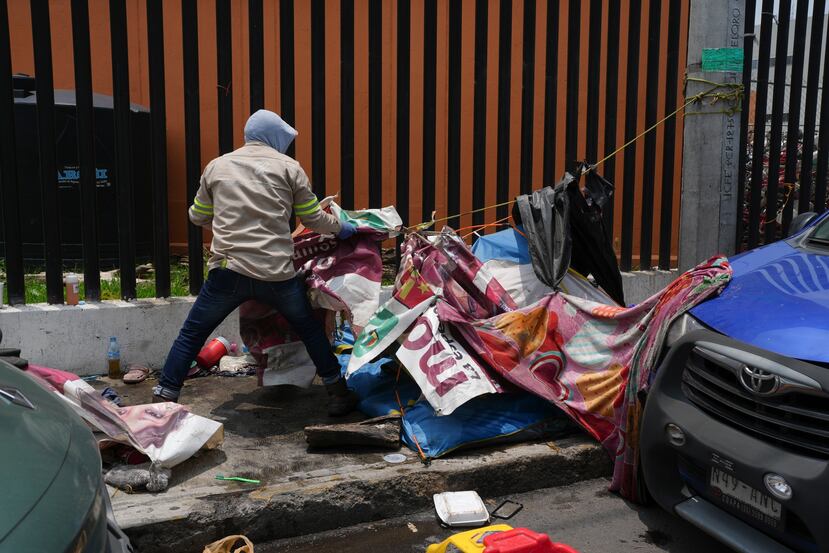
The camps are a swarm of tents and tarps. Some of the migrants call this space “ranchitos”: houses that they put together with boards, cardboard, plastic sheets, blankets and whatever they can find to protect themselves from the freezing mountain air and the intense summer rains that lash the city.
At another camp, in the central La Merced neighbourhood, hundreds of blue, yellow and red tents fill a square in front of a church. It is one of the largest in the capital and is just a 20-minute walk from the heart of the city.
“This is a place where up to 2,000 migrants have lived in the last year,” Bahena said. “Forty percent of them are children.”
Faced with the need, migrants living in La Merced have organized themselves into a small city. They built an improvised water pump that transfers water from the public network and distributes it on a fixed schedule. Each tent receives four buckets a day.
“At first there were a lot of problems, a lot of trash, and people here in Mexico didn’t like that,” said Hector Javier Magallanes, a Venezuelan migrant who has been waiting nine months for his appointment to request asylum in the United States. “We took care of eliminating all of that little by little.”
Seeing that the flow of migrants did not stop, he decided to form a group of 15 people to take charge of the security and infrastructure of the camp.
Despite these efforts, residents have been unable to prevent outbreaks of disease, sometimes worsened by variations in the weather.
Keilin Mendoza, a 27-year-old Honduran woman, explained that her children constantly get sick with the flu, especially her 1-year-old daughter.
“She is the one that worries me the most because she is the one that I have the hardest time getting back,” He said Mendoza has sought medical care from humanitarian organizations in the camps, but resources are limited.
According to Israel Resendiz, coordinator of the mobile team of Doctors Without Borders, the uncertainty in the camps also significantly affects the mental health of migrants. “It is not the same thing for a person to be waiting for an appointment when they have a resource,” he explained. “Maybe they can rent a hotel, a room or have some resource to have food.” Most, he points out, lack that.
Mexico City’s Ministry of Inclusion and Social Welfare and Interior Ministry did not respond to a request for comment from The Associated Press about the camps. Press representatives for Clara Brugada, the new mayor of Mexico City, said the issue should first be discussed at the federal level.
Meanwhile, tensions between local residents and camp residents have escalated, sometimes resulting in mass evictions of migrants.
At the end of April, residents of the elegant and central Juarez neighborhood blocked some of the busiest streets in the city, chanting: “The street is not a shelter!”
Eduardo Ramirez, one of the protest organizers, said it is the government’s job to “help these poor people who come from their countries looking for something better and who had the misfortune of passing through Mexico.”
“They fell asleep on the street because the government abandoned them,” said.
In another camp of about 200 families in the northern neighborhood of Vallejo, tensions and fear have increased.
“One day they threw chlorinated water at a child, another day they threw hot water at him”said Sonia Rodriguez, a 50-year-old Salvadoran woman who lives in the camp.
Despite having made an effort to build a “little shack” as decent as possible —with a grill for cooking, bunk beds and a television— his gaze dulls when he remembers that he has lived like this for ten months: in an improvised camp and no longer his home, with his things, his normal life.

