

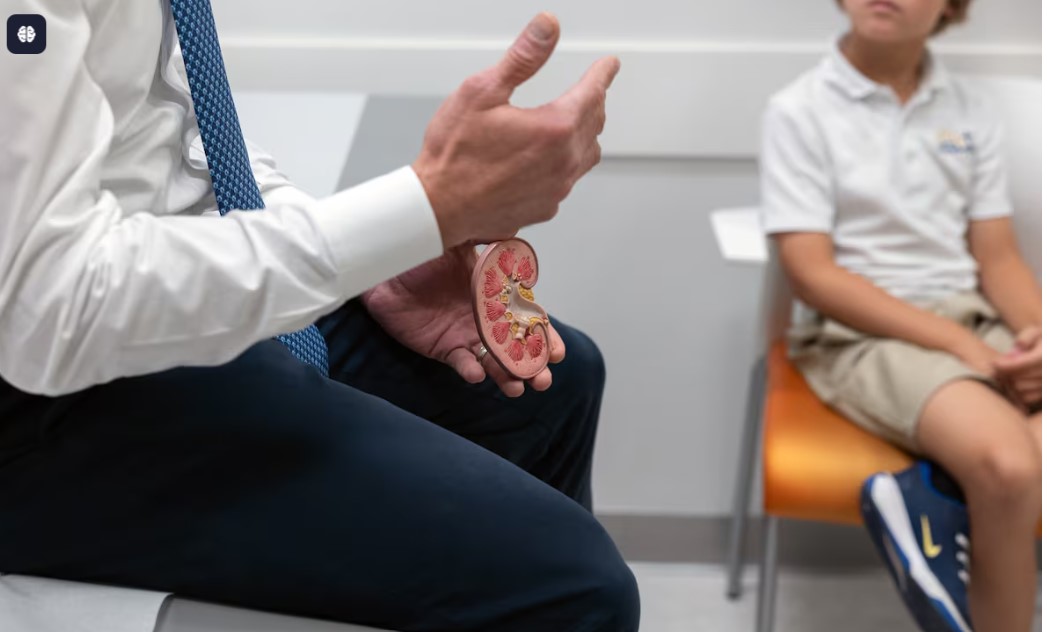
It’s a diagnosis more commonly associated with older adults.Pediatric urologist Gregory E. Tasian shows patients a model of a kidney with kidney stones at Children’s Hospital of Philadelphia in King of Prussia, Pennsylvania. (Rachel Wisniewski for The Washington Post)
“We see, everyday, children presenting with kidney stones,” Zachary V. Zuniga, a pediatric urologist at Texas Children’s Hospital, said. Some return repeatedly to the emergency room, and while not all require surgery, others will be hospitalized and need antibiotics.
Some health experts predict the problem will worsen.
“Historically, stones were pretty much a disease of white, middle-aged men, but that’s changed dramatically over the last 30 years,” said Gregory E. Tasian, a pediatric urologist at Children’s Hospital of Philadelphia who has conducted research on kidney stones in children.
Tasian said the disease affects adults and children in similar ways because the stones are often made of calcium oxalate, but the profile of pediatric and adult patients differs.
“They’re young. They’re healthy. They don’t generally have other comorbid conditions,” Tasian said.
Treating stones in children can involve medical management and, in some cases, surgical intervention.
Physicians typically begin by managing pain with over-the-counter medications or prescription drugs that help dilate the ureter muscles, enabling the stone to pass from the ureter to the bladder.
A child experiencing kidney stones may need antibiotics if they develop a urinary tract infection, which can occur when stones obstruct urine flow. Antibiotics can also be prescribed to prevent infections after a stone removal procedure.
A 2016 study in the Clinical Journal of the American Society of Nephrology analyzed kidney stone incidence among 15-to-19-year-olds in South Carolina from 1997 through 2012. Researchers found a 28 percent increase over a five-year period for girls. For boys, that increase was 23 percent.
Painful chronic conditions such as kidney stones can profoundly disrupt the lives of teenagers and children, forcing them to confront challenges unfamiliar to many of their peers. Pleskoff’s struggle with stones significantly disrupted daily activities, preventing her from participating in swimming, a sport she loved.
To manage her condition, Pleskoff adhered to a strict diet designed for people beset with kidney stones. The diet became a central focus of her life, dictating her food choices and daily routine. But the pressure to maintain this restrictive diet led to anorexia, she said.
“Just the idea that if I restricted my diet, I wouldn’t be in as much pain, and then I ended up restricting a little too much and not eating enough to keep my body healthy,” Pleskoff said.
With their heat-retaining infrastructure, cities create environments where dehydration and its consequent health issues become more prevalent. Sas said these health risks are poised to intensify as temperatures continue to rise.
Sas also pointed to school policies that act as barriers to proper hydration and kidney stone prevention.
The Healthy, Hunger-Free Kids Act of 2010 requires schools participating in the National School Lunch Program to make water available to students during meal times free of charge, but some schools limit access to water systems and prohibit students from carrying water bottles.
“I write a lot of letters saying that so-and-so must have free access to water and the restroom due to a risk of kidney stones,” Sas said.

