

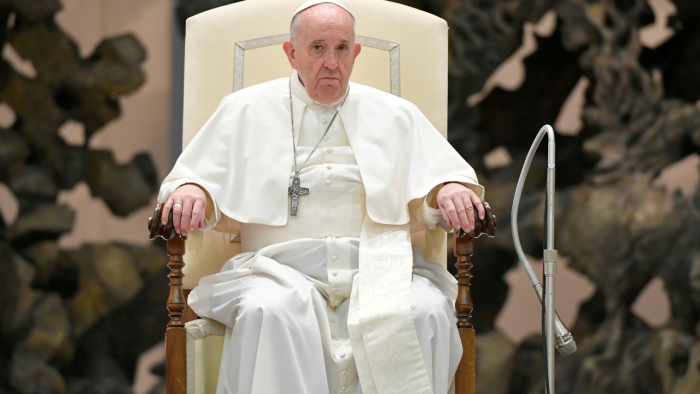
Pope Francis on Friday urged Iraqi authorities to value their religious minorities and consider them a precious resource to be protected, not an obstacle to be removed, as he began the first papal visit to Iraq with a call for tolerance and fraternity.
Francis told President Barham Salih and other Iraqi officials gathered at the Baghdad palace inside the heavily fortified Green Zone that no one should be considered a second-class citizen. He said Iraqis of all religions deserve to have the same rights and protections as the Shiite Muslim majority.
Only if we learn to look beyond our differences and see each other as members of the same human family can we begin an effective process of reconstruction and leave future generations a better, more just and humane world, he said.
Despite the coronavirus pandemic and concerns for their safety, Francis arrived in Iraq to try to encourage its dwindling number of Christians, who were violently persecuted by the Islamic State group and face continued discrimination from Shiite Muslims.
Francis is asking the shrinking Christian minority to stay in the country and help its reconstruction after years of war.
Iraq’s president said Friday that the papal visit is an opportunity to improve relations between Christians and Muslims, and that the pontiff’s decision to go ahead with the tour despite the pandemic and security fears had doubled its value.
In a meeting at the presidential palace with Francis, attended by other senior Iraqi officials shortly after the pontiff’s arrival, Salih lamented that the Middle East faces a crisis of coexistence due to regional tensions and extremism. He stressed the importance of peaceful coexistence and the preservation of Iraq’s nearly 2,000-year-old Christian community.
He said that the East cannot be imagined without Christians and that their dwindling numbers will have dire consequences. He expressed support for the establishment of an Abraham House for Religious Dialogue, named after the shared patriarch of Judaism, Christianity and Islam.
Iraq was home to nearly 1.5 million Christians before the 2003 U.S.-led invasion that toppled Saddam Hussein and plunged the country into chaos. Catholic Church leaders say only a few hundred thousand remain after years of instability and extremist attacks.
Francis’ plane landed at Baghdad airport shortly before 2:00 pm. A red carpet was rolled out on the tarmac where the prime minister, Mustafa al-Kadhimi, waited to greet him. The pope was visibly limping in a sign that his sciatica, which forced him to cancel several events recently, may be bothering him.
The pontiff wore a mask throughout the flight and held it to descend the stairs to the tarmac, where he was greeted by two children, also wearing face masks, dressed in traditional costumes. However, sanitary measures seemed to be more lax inside the airport in view of the new wave of contagions in the country.
Iraqi Foreign Minister Fuad Hussein described the visit as a historic encounter between the minaret and the bells. High on the agenda for his three days in the country is a private meeting on Saturday with the country’s top Shiite cleric, Grand Ayatollah Ali al-Sistani, a renowned figure in Iraq and beyond.
A choir, most of its members unmasked, sang songs as the pontiff and the prime minister walked to the airport reception area. People wandered around without face masks and the two leaders removed theirs as they sat down for their first meeting, in which they were not within two meters (yards) of each other.
Hundreds of people waited on the airport road hoping to see the papal plane land.
Iraqis were ready to welcome the pontiff and all the worldwide attention his visit will generate, with banners and posters decorating the center of the capital, Baghdad, and billboards with the image of the religious man and the slogan We are all brothers on the main avenue. A tree with the Vatican emblem was erected in Tahrir Square in the center of the city, while Iraqi and Vatican flags were placed along the empty streets.
The government wants to show the relative security it has achieved after years of war and insurgent attacks which, despite everything, continue today. Francis and the Vatican delegation rely on Iraqi security forces for protection, including the use for the first time of an armored car as the popemobile.
Tahsin al-Khafaji, spokesman for the Iraqi Defense General Staff, said the number of security forces was increased.
Francis breaks his year-long confinement for COVID-19 to return global attention to a largely neglected town whose northern Christian communities, dating back to the time of Christ, were left nearly empty during the violent rule of the extremist group Islamic State between 2014 and 2017.
For the pontiff, who has often traveled to places where Christians are a persecuted minority, those in Iraq epitomize the martyred church he has been an admirer of since he was a young Jesuit seeking to become a missionary in Asia.
In Iraq, Francis seeks not only to honor his martyrs but to offer a message of reconciliation and fraternity. The few remaining Christians in the country harbor a lingering distrust of their Muslim neighbors and face structural discrimination that predates ISIS and the 2003 U.S.-led invasion that plunged the country into chaos.
The visit coincides with a new spike in coronavirus infections in the country, where most of the new cases stem from a highly contagious variant first detected in Britain. The 84-year-old pope, the Vatican delegation and accompanying reporters have been vaccinated, but most Iraqis have not.
Ahead of the pope’s arrival Friday, dozens of men, women and children gathered at a Baghdad church, many without masks and obviating the security distance, before boarding buses to meet Francis at the airport.
Both Vatican and Iraqi authorities have downplayed the threat of the virus and insisted that social distancing, crowd control and other measures will be implemented. Vatican spokesman Matteo Bruni said this week that the important thing is for Iraqis to know that the pope is traveling to Iraq as an act of love.

