


Among the dozens and dozens of books that have been published about Roberto ClementeThere are already some books for children, but this Tuesday a new work was officially launched on the market, the aim of which is to inspire children to overcome prejudices.
Although the story of discrimination and even the mockery that Clemente received in life during his career in Major League Baseball has already been reported, the journalist Nathalie Alonso focuses on adapting the theme for minors, in a piece masterfully illustrated by the New York artist of Puerto Rican origin Rudy Gutierrez.
Alonso, born in the United States of Cuban descent, is a reporter for Major League Baseball (MLB) on its Spanish-language digital platform, las Mayores.com, and already has other publications for children. However, this one about Clemente’s life is her first that is not fiction.
Call me Roberto!: Roberto Clemente raises his voice for Latinosis a full-color illustrated book with a story told in 40 pages, recommended for children between 7 and 10 years of age. The book was released simultaneously in English and Spanish. The English version is titled Call Me Roberto!: Roberto Clemente Goes to Bat for Latinos.
Platforms such as Amazon have it available in hardcover and also in digital format.
“Roberto Clemente’s book was one of the first I wrote, but another one came out (published earlier) that is fiction. I sold Clemente’s book (to the publishing house) in 2020 and it is coming out now,” Alonso explained in a telephone interview with The New Day“It’s a very long process for illustrated books.”
“I wanted to write for children and I got into that world, in workshops, to learn everything about the industry. I am Latina, my family is Cuban, but since I grew up here in the United States, in New York, the narrative I knew about Roberto was how he died. He was the humanitarian figure who died. That was the concept I had of him mainly. But working in baseball for Major Leagues, interviewing Puerto Rican players, I learned to be involved in that whole world. I realized that there was another aspect of his legacy that I didn’t know as much about, which was his fight for social justice against racism. I came to understand that as an adult.”
As for the sporting side, it was another angle that Alonso knew from his work in the Major Leagues, where achievements and success are regularly reviewed. story of the first Latin American baseball player to reach the figure of 3,000 hits in his career, and also the first to be inducted into the Hall of Fame.
The writer feels to a certain extent represented in American society by the figure of Clemente, because although she was born in the United States, she says that since she entered the workforce, at 20 years of age with MLB, she always felt somewhat out of place, specifically when in press conferences she wondered to herself whether or not she should ask questions in Spanish.
Nowadays, for several years now, it has been common practice in the Major League Baseball world for English-speaking and Spanish-speaking journalists to take alternating turns asking questions in both languages, when the interviewee is fluent in both.
When the author came across the video that is still circulating, of a Clemente interviewed for national television after his Pittsburgh Pirates They won the 1971 World Series, and in which the Puerto Rican first spoke in Spanish to dedicate a few words to his parents in Puerto Rico, it was for Alonso a reinforcement of her identity as a Latina.
This personal situation was what helped her to decide on the angle she wanted to explore and present in her work on Clemente. In the meantime, she received a scholarship from an organization that allowed her to study to become a writer.
“I already had support to present more concrete projects. That was my opportunity. I said to myself, ‘I want to do this book.’ I know that I am not teaching any Puerto Rican anything with this book. Nothing that they don’t already know. But I feel that here in the Anglo market, there was no such book that explored Clemente’s legacy from that angle, from that of social justice.”
Alonso agrees with the idea that at first glance, the topic may seem inappropriate for children, but at the same time, it is vital that it is addressed by parents.
“It’s a tool for that conversation (with the children),” said the writer, whose book exposes several of the circumstances that Clemente suffered, such as the mocking treatment by the American press itself due to his accent.
For his part, the illustrator, upon receiving the approach from the publishing house to work on the book written by Alonso, stated what his initial position was. The artist, who does not even speak Spanish but identifies himself as Puerto Rican born in the Bronx, admitted that if it had been another book by Clemente to expose the subject of baseball, his response would have been negative.
Gutierrez, 67, has a long career as an artist and in addition to illustrating various books and publications, he has designed album covers for legendary artists Carlos Santana and Paul Simon, among others.
“If the book had been about his game, I wouldn’t have been interested. I was interested in the truth of his life,” he said, clarifying that it’s not that he doesn’t like baseball. In fact, he said he played quite a bit of it during his youth.
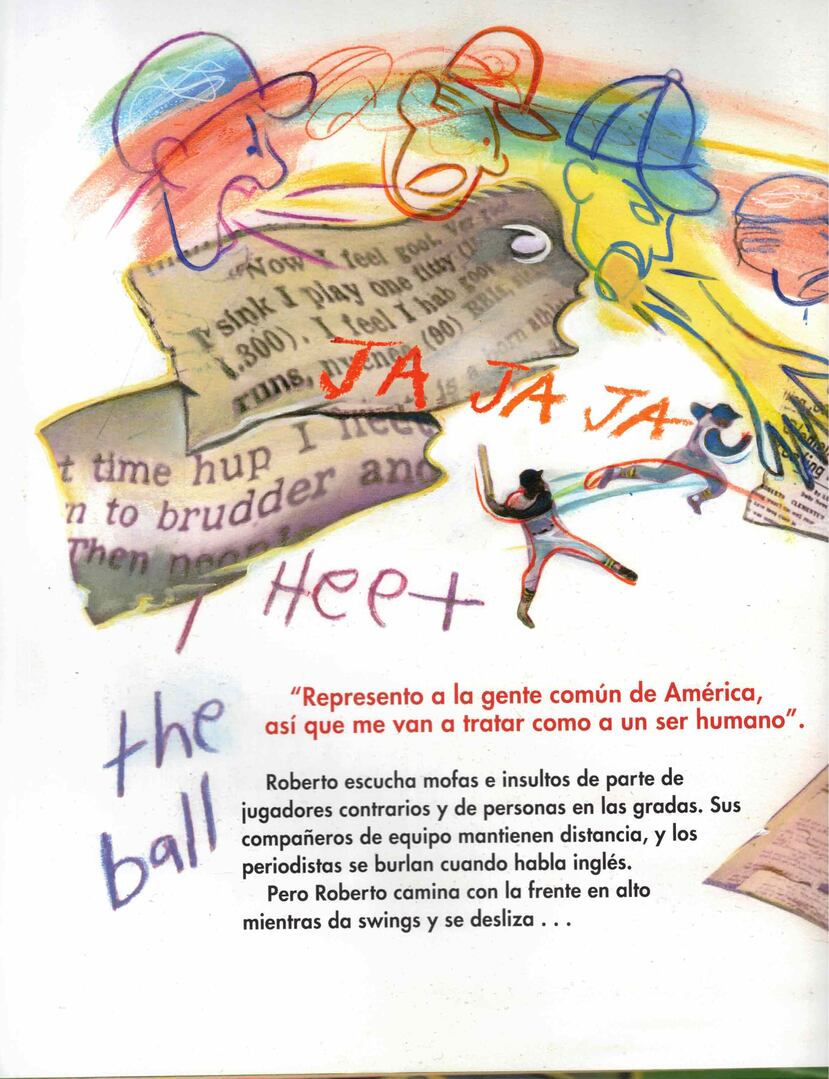
“When I was growing up, Roberto Clemente was a hero of mine. And not only for his baseball skills, which have been described as poetry in motion, but also for his love of culture, of Puerto Rican culture, which I feel very proud of, and also related to, for his integrity, his justice and his sense of responsibility not only to Puerto Ricans, but to other Latinos,” Gutierrez told this media outlet.
The illustrator described the process as a long one that included a lot of research, looking at old photos and videos from the time, and then starting to draw up rough drafts until reaching the final phase of adding color.

