

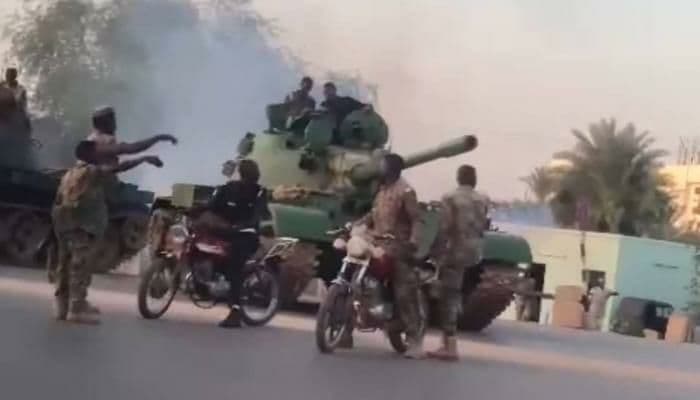
Pro-democracy protesters on Tuesday cut off some streets in Sudan’s capital with makeshift barricades and burning tires, the day after the military took control of the…
Pro-democracy protesters on Tuesday cut off some streets in Sudan’s capital with makeshift barricades and burning tires, the day after the military took control of the country in a swift coup condemned by the international community.
The prime minister and other members of the transitional government, detained Monday by the army, were still being held in a military camp outside Khartoum, the capital.
The military coup threatened to derail Sudan’s fragile transition to democracy, which has been underway for two years. The U.N. Security Council was scheduled to address the situation Tuesday in a closed-door meeting.
Western governments condemned the coup and called for the release of the prime minister, Abdalla Hamdok, and other leading officials. The administration of U.S. President Joe Biden announced the suspension of $700 million in emergency assistance to Sudan.
There was a mass protest called on Saturday to demand a return to civilian rule.
The Sudanese army seized power on Monday, more than two years after a popular uprising forced the ouster of longtime autocrat Omar al-Bashir. In response, Sudanese flooded the streets of Khartoum and elsewhere in protest. At least four people were killed and more than 80 injured when security forces fired on protesters in Khartoum, according to the Sudan Doctors Committee.
Gen. Abdel-Fattah Burhan, Sudan’s highest-ranking military officer, dissolved Hamdok’s government and the Sovereign Council, a joint civilian-military body set up shortly after Al-Bashir’s deposition to run the country. He now heads a military council that he says will rule the country until an election in July 2023.
Burhan justified the military coup by the divisions and quarrels between political factions, and claimed that these differences threatened the integrity of the country. However, the coup came less than a month before Burhan was due to hand over command of the Sovereign Council to a civilian, a step that would have reduced the Army’s power.
The general said he was serious about holding elections as planned. But 19 months before the date, it was not clear that the military was willing to relinquish the control it had wielded for decades.

