

Buffalo, New York— The man convicted of trying to murder Salman Rushdie spent years investigating the writer’s whereabouts before stabbing him on stage at a conference, federal prosecutors said Wednesday at the opening of his federal terrorism trial.
This is the second trial against Hadi Matar, who was found guilty last year in an attempted murder case in the state of New York. The federal terrorism charges focus more on Matar’s alleged motive for the 2022 attack on the renowned author and free speech advocate.
Prosecutors began working Wednesday to convince the jury that Matar was trying to follow a 1989 fatwa, or religious ruling, that called for Rushdie’s death because of what some Muslims considered blasphemy in his 1988 novel “The Satanic Verses.”
“Compliance with the fatwa: that is what Hadi Matar intended to do,” said Assistant United States Attorney Timothy Lynch in his opening statement in federal court in Buffalo, New York, about 70 miles from the artistic and intellectual center where Rushdie was attacked. The Booker Prize-winning author is expected to testify later this week about the stabbing that almost cost him his life and left him blind in one eye.
Defense attorney Nathaniel Barone urged jurors to keep an open mind.
“You will have to ask yourself: what was Hadi Matar’s intention?” Barone said in his opening statement. “The government does not know what Hadi’s intentions were or what his mental state was at any time, frankly.”
The Prosecutor’s Office maintains that Matar’s writings, communications and other materials demonstrated that he was acting out of loyalty to the theocratic government of Iran and the Iran-backed militant group Hezbollah; It was the late Ayatollah Ruhollah Khomeini who issued the fatwa.
Public witnesses Rushdie stabbing
Matar, 28, has pleaded not guilty to the federal charges against him, which include participation in an act of transnational terrorism. He is currently serving a 25-year sentence in a New York state prison and faces a possible life sentence if convicted in the federal prosecution.
The attack — which jurors saw on video Wednesday — took place before a horrified audience at the Chautauqua Institution, where Rushdie was about to give a talk on writers’ safety.
His attacker, wearing a medical mask, strode onto the stage and stabbed Rushdie repeatedly, not stopping even when the writer stood up and fell on his back. Onlookers rushed to push the attacker away from Rushdie and keep him face down until a state police officer arrived.
As one of the videos played, Matar, 28, rested his head several times on the defense table before looking up at the screen again. Otherwise, he spent much of the time taking notes on a yellow legal pad and exchanging comments with his lawyers.
Rushdie, now 79, has recounted the assault and his long recovery process during the previous Matar trial, in his memoirs and in numerous interviews.
“What happens when you face death very closely — the closest you can get without actually dancing the dance of death and leaving for nothing — is that it stays with you,” he told The Associated Press in 2024. “There is a shadow left.”
Revolves around the motivation of Killing
Born in the United States to parents who emigrated from LebanonMatar has the nationality of both countries. His mother has stated that he became temperamental and withdrawn into himself after a trip to Lebanon in 2018, where Hezbollah is based.
Prosecutors say their attack on Rushdie was prompted, in part, by statements that late Hezbollah leader Hassan Nasrallah made in 2006, amid controversy in the Muslim world over caricatures of the Prophet Muhammad published in European newspapers. Nasrallah opined that “the problem began the day Salman Rushdie wrote ‘The Satanic Verses’” and that the controversy over the cartoons would not have taken place if someone had carried out Khomeini’s fatwa.
Matar began researching Rushdie in 2020, asking his online contacts where the writer lived and eventually finding out where he had his office, what sports teams he followed and where he watched games, Lynch explained in his opening statement. He claimed that Matar kept sticky notes and a notebook about his project.
“We have to kill him as soon as possible,” Matar wrote, according to the prosecutor. He stated that Matar justified the murder as part of what he considered a jihad, or holy war, and added: “Become a warrior and end this once and for all.”
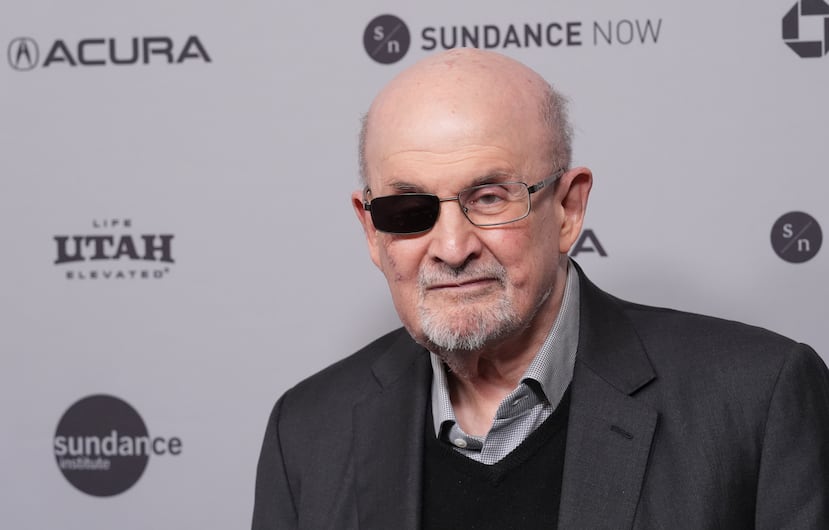
In Matar’s room in New Jersey, federal agents found photos of Khomeini, his deceased successor Ayatollah Ali Khamenei and a Hezbollah figure, Lynch explained. A photo of him giving the military salute in a Hezbollah-related T-shirt was found on Matar’s computer, as well as a video about Khomeini’s fatwa, and Matar asked a contact in 2022 if the edict was still in force, according to the prosecutor.
According to the prosecution, on the day of the attack, Matar was carrying a false driver’s license in the name of a member of Hezbollah.
“The defendant wanted everyone to know that he was doing it for Hezbollah,” Lynch told the jury.
Matar declined to testify at his state court trial, and it is unclear whether he will take the stand in federal court. At his sentencing hearing in state court, Matar said he believed in freedom of expression, but called Rushdie a “hypocrite” and a “thug.”
How the Ayatollah’s fatwa affected Rushdie
Rushdie was born in India, raised in Britain — where he was knighted by the late Queen Elizabeth II — and is now an American citizen. He won the Booker Prize in 1981 for his novel “Midnight’s Children” and achieved his greatest fame—and notoriety—with “The Satanic Verses.” A dream sequence about the Prophet Muhammad sparked protests, often violent, against Rushdie, who was born into a Muslim family.
Khomeini’s 1989 fatwa forced Rushdie to live underground for years. Although the edict was revoked, Iran has not paid attention to it in recent years. The Iranian government denied any involvement in the 2022 stabbing, but its then-foreign ministry spokesman suggested Rushdie had brought trouble on himself by insulting Islam.
Nasrallah, leader of Hezbollah, did not comment on the attack.
After “Knife,” Rushdie’s memoirs about the stabbing, he returned to fiction with “The Eleventh Hour,” published last year, a book of short stories and novellas. In November he was awarded the Dayton Literary Prize for Peace, in recognition of his entire career.

