


USA It lifted its blockade on Iran on Thursday, and oil tankers began moving freely through the Strait of Hormuz after months without being able to use it, after it came into effect the tentative agreement to end the war.
Meanwhile, US Vice President J.D. Vance announced that he might postpone a trip to Switzerland that was scheduled for Friday and included a ceremonial signing of the agreement. And in a private briefing, an envoy from President Donald Trump’s administration told U.S. lawmakers that Iran will invite the U.N. nuclear watchdog to inspect its nuclear facilities.
In other events, Iran’s supreme leader, Ayatollah Moytabkha Khamenei, backed direct negotiations with Washington in a statement read by state media.
“It is clear that the face-to-face negotiations that will take place in the future will not mean accepting the opinion of the enemy,” he declared.
It was Khamenei’s first reaction to agreementand indicated a change in Iran’s approach. Hardliners, especially Khamenei’s father, the previous supreme leader, have long opposed direct talks, especially after the United States withdrew from the 2015 nuclear deal between Tehran and several world powers.
The supreme leader has not been seen in public since he was wounded in an attack when the war began.
Trump envoy tells lawmakers Iran will invite UN inspectors to its nuclear facilities
Separately, U.S. envoy Steve Witkoff told lawmakers that Iran will invite the U.N. nuclear watchdog to inspect its nuclear facilities, and will begin work on identifying and finding the sites of Tehran’s enriched material, believed to be buried under rubble.
Two people familiar with the conversation described the closed-door briefing, speaking to The Associated Press on condition of anonymity to share details.
Witkoff informed Congressional leadership and members of committees related to national security that the agreement the United States reached with Iran does not include any side agreement, but that an additional letter was drafted between Tehran and the International Atomic Energy Agency that extended the invitation.
According to sources, in the briefing session Witkoff revealed the existence of the letter and the invitation.
Witkoff noted that the letter addressed to IAEA Director General Rafael Mariano Grossi would allow him to bring US nuclear inspectors to Tehran.
The deal states that Iran’s stockpile of highly enriched uranium must be diluted under international supervision, at a minimum. It also establishes that the country must not acquire or develop nuclear weapons, a commitment it has previously made.
Uncertain timeline could make it difficult to push through deal
Vance’s visit could have helped start talks about the next — and potentially even more crucial — round of negotiations between the two sides.
Pakistani Prime Minister Shehbaz Sharif also postponed a planned visit to Switzerland, where Islamabad officials were to host the ceremony, because the agreement had already been signed, said two senior officials, both of whom spoke on condition of anonymity because of the sensitivity of the matter.
The now uncertain timeline could raise new questions, and make it even more difficult for the Trump administration to advance a deal that many in the United States — including some congressional Republicans — have criticized as too favorable to Tehran.
“Our plan is to go to Switzerland. I don’t know exactly when,” Vance said during a briefing with reporters at the White House when asked about the possibility of him not going to the signing ceremony.
That introduced new doubts to an agreement that Trump said he signed to avoid an “economic catastrophe” in the United States.
Vance made his announcement a day after the president signed the Iran pact while dining with French President Emmanuel Macron at the Palace of Versailles. The agreement should take effect immediately and extend the ceasefire, while giving each side 60 days to reach broader agreements on larger issues.
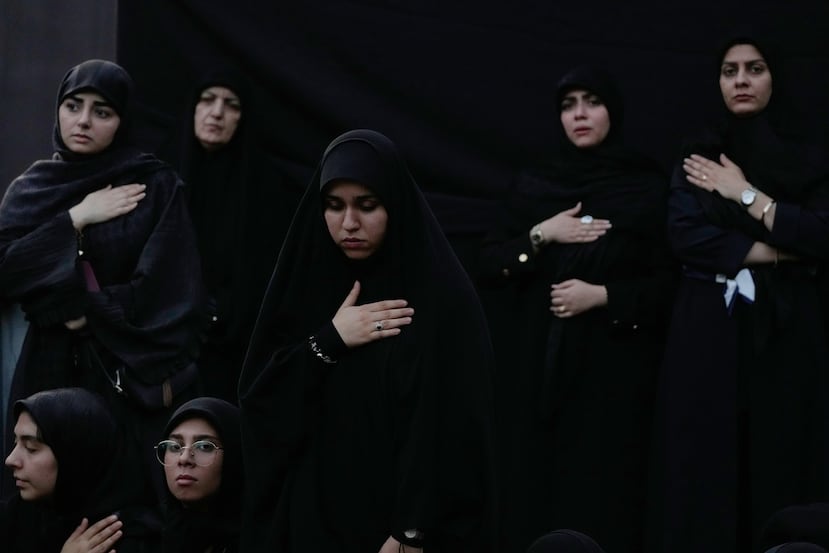
1 / 10 | In photos: Iran pays tribute to those who fell in the war with the United States and Israel. The United States has blockaded Iranian ports for more than a month, and Trump said Sunday that the blockade “will remain in full force until an agreement is reached, certified and signed.” – Vahid Salemi
Trump said the pact would prevent further stress on the U.S. economy after the war caused a spike in oil prices, jitters in financial markets and a spike in inflation. He reiterated that he did not want to be compared to President Herbert Hoover, whose policies helped aggravate the Great Depression of the 1930s.
Vance defends the Iran deal
The vice president, who was initially skeptical that the United States would go to war with Iran, has increasingly become the face of the administration in the conflict and has been eloquent in defending the deal. Asked about concerns that it concedes too much, Vance repeatedly said the deal would force Tehran to “change its behavior.”
The official downplayed accusations that its implementation has been piecemeal and sometimes contradictory, saying: “I don’t think our messages to the public have been chaotic.”
He also offered a surprisingly direct warning to Israel, which has pressured the United States to take a tougher stance on Iran and attacked the Iran-backed political-paramilitary group Hezbollah in Lebanon throughout the war, even before the agreement extending the ceasefire was reached. These attacks complicated peace efforts with the Iranian government.
Trump “is the only head of state in the entire world who sympathizes with the nation of Israel right now,” Vance noted. “And he happens to be the head of state of the world’s superpower.”
The vice president noted that more than 12.5 million barrels passed through the Strait of Hormuz on Wednesday night. That could further dampen oil prices, which soared during the war but have been falling since the United States and Iran announced the tentative deal to end the conflict.
He said easing the US blockade on Tehran means “fulfilling our part in the first stage of the agreement on the military level.”
U.S. Central Command said U.S. warships “will remain in the general area to ensure that all aspects of the agreement are met, obeyed, and in full force and effect.”
Maritime transport begins to rebound
At least two tankers left Iran and passed through the US military blockade without being detained. A merchant shipping tracking website indicated the ships were carrying a combined total of 3.8 million barrels of Iranian crude.
Meanwhile, Iranian state media reported that shipping has been “normalized” in Iran’s southern ports, but added that the Strait of Hormuz remains monitored and under the control of the Iranian military, and that transiting the crucial sea lane still requires coordination.
According to maritime data company Lloyd’s List Intelligence, prominent shipping companies have begun moving ships through the Strait of Hormuz since the agreement was signed, although it did not provide data on how many ships have transited the strait as of Thursday.
In a briefing, Richard Meade, editor-in-chief of Lloyd’s List, said that for the first time in 110 days, ships owned by major companies are passing through the strait after being virtually stranded there since February.
Tankers controlled by shipping companies such as Grimaldi Group, Cosco, Knutsen and NYK have passed through the strait. And two sanctioned tankers, flying the Iranian flag and owned by the National Iranian Tanker Company, have entered the strait, according to Lloyd’s List.
Phillip Belcher, maritime director of Intertanko, a trade group of independent global tanker owners, said the main Strait of Hormuz central route remains closed and has approximately 80 mines, which must be removed.
But some ships have been passing through the smaller northern route, which passes through Iranian waters, and the southern route, which passes through Omani waters.
Lloyd’s List estimated that 550 merchant ships will have to leave the Persian Gulf. It could take weeks or months to fully reopen the strait, and the two alternative routes do not have as much capacity as the central Hormuz passage.

