

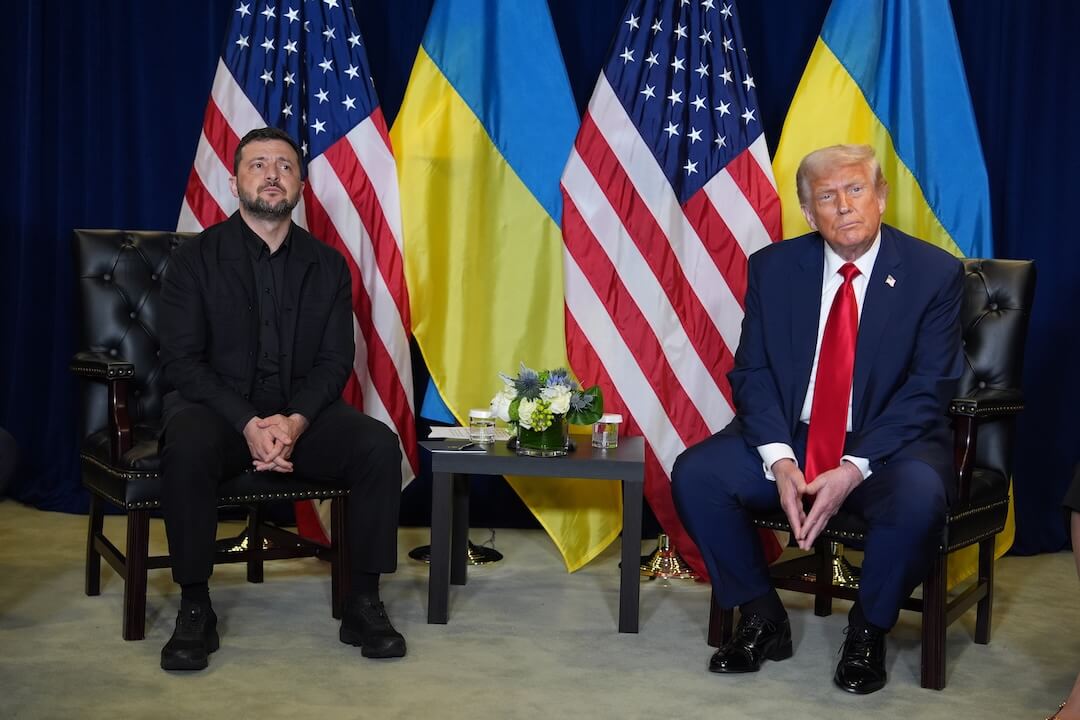
In a White House visit with Ukrainian President Volodymyr Zelenskyy, Donald Trump boosted his frequent boast about resolving wars and made an even bolder claim: that no president before him had solved even one war.
On Oct. 17, Trump asserted that “Sir, if you solve one more, you’re going to be known as a peacekeeper. So to the best of my knowledge, we’ve never had a president that solved one war, not one war. (George W.) Bush started a war (in Iraq). A lot of them start wars, but they don’t solve the wars. They don’t settle them, and especially when they’re not, when they have nothing to do with us.”
Trump’s statement ignores centuries of history in which U.S. presidents or their envoys brokered peace, often with Nobel recognition for the negotiators or principal participants. Historians andFact-checkers note that at least two presidents personally oversaw successful peace negotiations, and several others shepherded settlements through the diplomacy of their administrations.
Key clarifications from researchers:
- Theodore Roosevelt helped mediate the settlement of the Russo-Japanese War in 1905, for which he received the 1906 Nobel Peace Prize.
- Jimmy Carter presided over the Camp David Accords in 1978, bringing Egypt and Israel to a peace agreement; Sadat and Begin shared the 1978 Nobel Peace Prize.
Beyond presidents directly negotiating, other administrations saw peace accords negotiated by presidential appointees:
- The Dayton Accords, ending the Bosnian War in 1995, were driven by U.S. diplomat Richard Holbrooke and Secretaries of State, with President Bill Clinton in office.
- The Northern Ireland Good Friday Agreement in 1998 followed shuttle diplomacy led by former Senate Majority Leader George Mitchell during Clinton’s presidency, culminating in peace talks brokered with U.S. involvement.
- The 2005 Sudan Comprehensive Peace Agreement, ending civil conflict in Sudan (leading to South Sudan’s eventual independence), involved negotiations overseen by U.S. officials under President George W. Bush.
Trump’s broader claim that he has ended “six, seven or eight wars” has repeatedly appeared in his rhetoric. While he cites recent ceasefires and negotiations—such as deals related to Israel-Iran, India-Pakistan, Armenia-Azerbaijan, and other intermittent agreements—these efforts are often viewed as partial, tentative, or part of longer, complex processes rather than decisive, lasting resolutions that end wars alone.
Current status of notable efforts:
- Israel-Hamas ceasefire arrangements involve multiple parties, and peace there remains unsettled and evolving.
- Egyptian-Ethiopian tensions, particularly over Nile water projects, continued to present disputes beyond the scope of any single negotiating moment.
- Kosovo-Serbia relations have seen gradual progress but not a final, comprehensive peace settlement.
- Some regional ceasefires have paused violence but have not produced enduring peace.
Our assessment
Trump’s claim that no president before him solved even one war overlooks well-documented instances where U.S. presidents or their appointees played pivotal roles in ending conflicts or securing negotiated settlements. Theodore Roosevelt and Jimmy Carter are clear examples of presidents who oversaw peace breakthroughs, and many other administrations achieved peace through diplomacy conducted under presidential authority.
We rate Trump’s statement Pants on Fire.

