
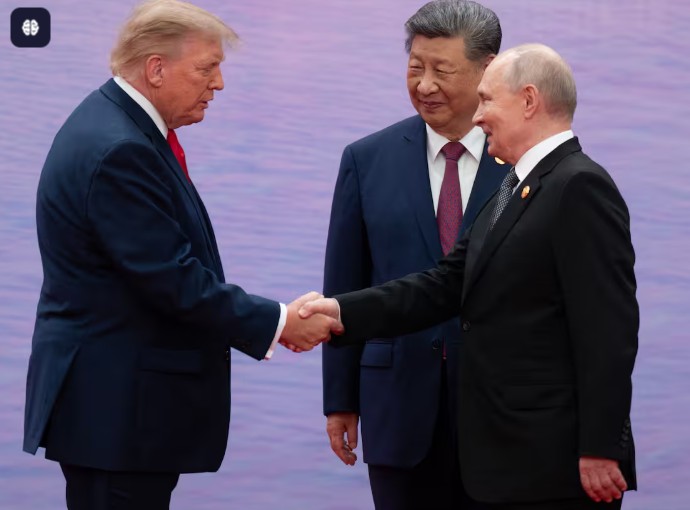
The White House’s insistence that denuclearization will be part of this week’s talks has rankled Chinese authorities.
Less clear is whether China has any interest in such discussions.
At a news conference on Monday, Chinese Foreign Ministry spokesperson Mao Ning declined to answer whether nuclear weapons talks would be included in the summit. When Secretary of State Marco Rubio spoke with Chinese Foreign Minister Wang Yi last week, the U.S. readout of the call noted that the two had discussed “the importance of meaningful leader-level conversations to advance goals such as peace and denuclearization.” The Chinese readout did not mention nuclear weapons at all.
“That’s not up for discussion [at APEC]. China’s position is clear on this, it’s always been clear,” said a Chinese official, who spoke on the condition of anonymity, citing the sensitive diplomacy.
China’s nuclear stockpile has roughly doubled in the past decade. It has about 600 warheads compared with roughly 4,000 militarily available weapons each for the United States and Russia, which together constitute about 86 percent of the global total inventory of nuclear weapons, according to estimates by the Federation of American Scientists.
Even that initial diplomatic foray may prompt some resistance from the Chinese side, according to analysts.
“There is very little political will in Beijing to entertain substantive trilateral nuclear control talks,” said Tong Zhao, an expert on China’s nuclear program at the Carnegie Endowment for International Peace. “China wants to make sure that the United States and Russia bear the responsibility for reducing their nuclear arsenals, and it wants to avoid any indication that China shares that responsibility.”
For decades, China maintained a relatively small nuclear deterrent, but while it is still far from being a nuclear peer to the U.S. and Russia, it is catching up fast. The Pentagon has estimated that at its current rate of expansion, China could have a stockpile of around 1,500 nuclear warheads by 2035.
Other Defense Department assessments of China’s growing arsenal have pointed to the development of smaller, lower-yield nuclear weapons that could give Beijing more options for limited nuclear strikes, rather than relying primarily on larger, more destructive weapons designed for retaliation against major attacks.
Satellite imagery has revealed rapid work on new tunnels and deep shafts at China’s Lop Nur nuclear testing site, one of the country’s most secretive testing facilities, as well as an expansion of a site used to manufacture nuclear warhead components.
In February, the U.S. undersecretary of state for arms control and international security, Thomas DiNanno, made the surprise accusation that Beijing had secretly conducted a nuclear explosion in June 2020 — which, if confirmed, would be a breach of the Comprehensive Nuclear-Test-Ban Treaty. China, which signed but never ratified the treaty, has denied the allegation.
Beijing widely viewed the accusation as part of a White House effort to push more substantive negotiations on nuclear arms control, the Chinese official said.
Nuclear risk is a long-standing and prominent concern for Trump — motivating his controversial diplomatic outreach to North Korea in his first term, the war with Iran in his second, and the “Golden Dome” missile defense project. At the same time, the president — who once said in a Washington Post interview that nuclear weapons were “the biggest risk for this world” — is presiding over a more than $70 billion modernization of America’s nuclear deterrent and has called for the resumption of nuclear test detonations.
When the U.S. withdrew in 2019 from the Intermediate-Range Nuclear Forces Treaty, a key Cold War-era nuclear pact with Russia, Trump argued that it should be replaced with a deal that included Beijing, saying, “We’d certainly have to include China at some point.”
Trump officials criticized the Obama-era New START Treaty with Russia, which placed limits on both countries’ deployed warheads and launches on the grounds that it did not address China’s growing program. Attempts during Trump’s first term to bring China into negotiations over potentially joining New START were rebuffed, and the treaty formally expired in February.
In November 2023, President Joe Biden and Xi agreed to resume nuclear arms control talks after a nearly five-year hiatus. About eight months later, Beijing abruptly suspended the discussions in retaliation for U.S. arms sales to Taiwan, underscoring how even limited cooperation on nuclear security could become hostage to disputes elsewhere in the relationship.