

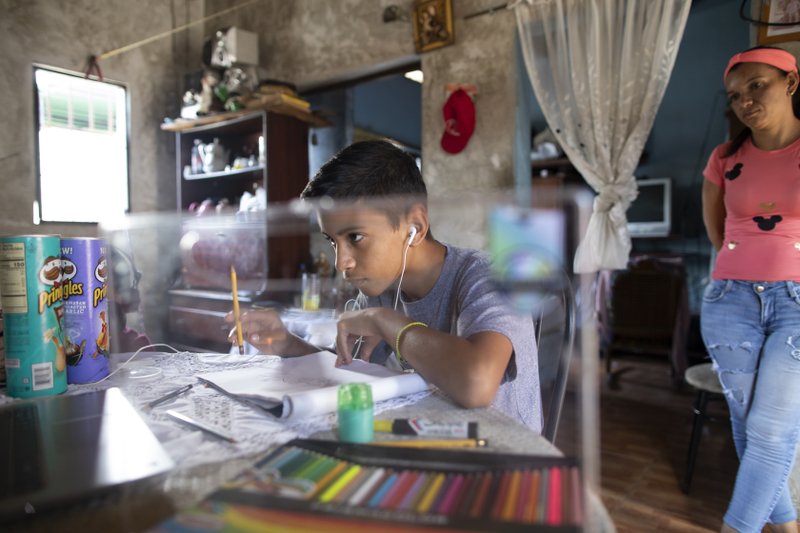
hoping to earn a little money and give his family a respite from the economic challenges they face like most residents of this troubled South American country.
Hi, I’m Samuel. I sell my drawings for a dollar to help my mom with my diet, buy her a house and a bodega so she doesn’t work on the street and get sick from COVID and buy a peanut butter for me, thank you sir and ma’am, he tweeted along with photos of four drawings. Her tweet went viral, and from this table with a woven tablecloth, placed between a worn couch and a rusty fridge, she has drawn and sold dozens of illustrations.
Truth be told, I didn’t know I was going to draw like this, but time has passed and I’ve managed to really paint, said Samuel, 14, in early March, proudly showing off his finished drawing of Goku, a character from the Japanese animated series Dragon Ball. And here it is.
Samuel, his mother and two brothers live in Barquisimeto, once a thriving agro-industrial city located about five hours west of the Venezuelan capital. In a country where workers earn an average salary of two dollars a month, their drawings can make a big difference in the family budget.
Venezuela is mired in a deep political, social and economic crisis, which many critics attribute to two decades of socialist governments that have left the once oil-rich country bankrupt. The country is also in its sixth year in recession, and its residents are grappling with high food prices set in dollars, low wages and four-digit inflation, condemning millions to live in poverty.
The crisis has forced nearly five million people to leave Venezuela in recent years in search of better living conditions.
Samuel and his mother, Magdalena Rodríguez, emigrated to Colombia in 2019 when widespread blackouts in Venezuela coincided with the teenager’s diagnosis of malnutrition. But, Rodriguez said, the duo returned to their home country in December after she lost her job and Venezuelans in the Colombian community where they lived were discriminated against after a group of immigrants robbed a grocery store.
Since returning to Venezuela, she has struggled to earn money and buy food, which is particularly crucial for the budding artist. Malnutrition, which Rodriguez says has caused her to lose muscle mass, requires her to follow a strict, protein-rich diet of six meals a day: breakfast, lunch and dinner and a snack between each.
Doing it right, it would be about $100 a week,” said Magdalena, referring to Samuel’s diet. It’s not easy, we don’t get there because of the high cost of food.
Rodriguez can occasionally afford to buy fish, which is rich in protein, but only enough for Samuel to eat, not for the whole family. Samuel also has Asperger’s syndrome, which Rodriguez said causes him anxiety, leading him to seek refuge in food.
Samuel said he started drawing when he was five years old. These days, the young boy needs to listen to music while he draws. He wants to buy his mom a house so he can have a more spacious room.
Some who discovered Samuel’s Twitter account have asked for 10 drawings at a time. He has a penchant for anime characters, but has also drawn soccer superstar Cristiano Ronaldo and the animated character SpongeBob SquarePants.
Venezuelan artist and muralist Oscar Olivares, who runs an art academy, saw Samuel’s tweets and awarded him a scholarship to study drawing. His social media followers have also gifted him a laptop computer, an expensive set of colored pencils and peanut butter, a good source of protein.
Samuel said he might raise the prices of his drawings now that he has moved up a level in his academy classes. He’d like to make YouTube-style videos about video games when he’s older.
Before Samuel’s tweet went viral, his mother used her own Twitter account to apply for a job. That landed her a cleaning job and someone set up an online fundraising account for her.
Rodriguez, 38, discovered Samuel’s effort when he asked her for her bank account information so people could pay for her artwork. The money has also enabled them to buy products that she can sell at a small snack stand in downtown Barquisimeto.
On a recent trip to a cooperative near her home, Rodríguez bought some food for the family, including several jars of baby compote, a box of cereal and beans. She paid about eight dollars in cash. The mother buys dollars to protect herself from the continued devaluation of the bolivar, the local currency.
Proud of him, really, I have no words,” said Rodríguez. But, yes, sometimes I feel anger, I feel impotence, because I think that at his age he has to be learning, studying and not wanting to work so he wants to help me when I am the one who has to do everything possible to give us comfort and food.

