


It is rare to see meetings between great figures where the main theme is to celebrate the career of an artist who has achieved the status of “legend”. In a way, that is, to a large extent, the aspiration of many. But only a few can do it and Raul Julia was one of them.
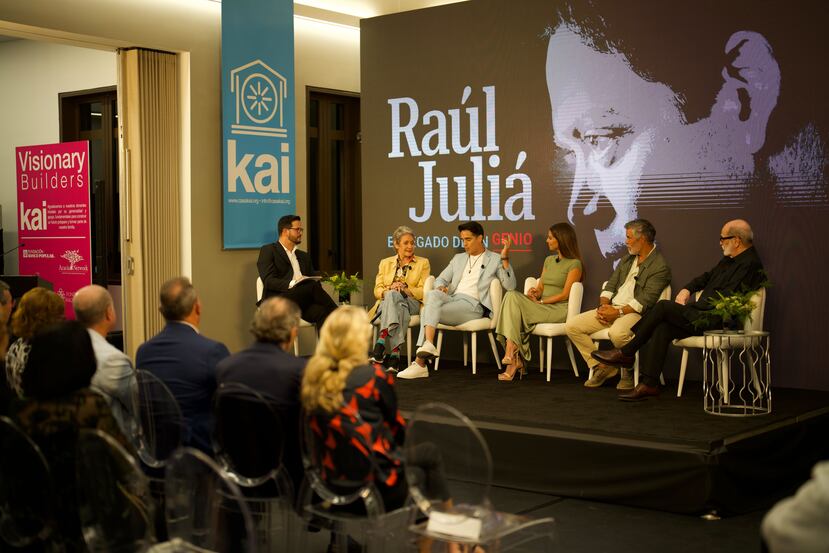
As part of the special project “Raul Julia: the legacy of a genius”, The New Day held an event dedicated, precisely, to the celebration of one of the most transcendental figures in Puerto Rican arts in Kai House of Art and Technology (Kai House), in Santurce.
The evening began with an artistic and musical presentation prepared by a group of Casa Kai students, entitled “Art and its strength”, inspired by the life of Julia and, more generally, on the importance and challenges faced when deciding to dedicate oneself to the world of the arts. The presentation consisted of a narration in which the students, using the concept of a forest as a metaphor, offered a powerful reflection and invited present and future generations to follow the example of the Puerto Rican actor and dare to dream.
Merel Poloway JuliaJulia’s wife, She took a brief moment to thank those present and her country for the love it always showed Raul. She also called on everyone to know where he comes from in order to get to know her husband well. “I am not exaggerating when I say that Raul had the life of his dreams. I, along with my sons Raul and Benjamin, thank Puerto Rico with all my heart. We love them and we are very grateful,” he said.
A panel composed of the actors Esai Morales, Roselyn Sanchez, Ivonne Coll, Hector Rivera and the filmmaker Marcos Zurinaga was the main event of the evening. The discussion was led by GFR Media’s editor-in-chief, Rafael Lama Bonillaand during the conversation these great figures of the island’s cultural and artistic activities shared some of their experiences related to Raul Julia and discussed the meaning of his legacy in Puerto Rico and the world.
“Raul Julia passed away 30 years ago; however, today, studying his performance, his acting record, his character and his humanitarian work, we realize that there are few people like him. “At El Nuevo Dia, our mission to continue educating and informing also includes rescuing the stories of our heroes so that future generations can be inspired and follow that legacy,” explained Lama Bonilla about the nature of this project and the event.
“When we were going to start making ‘The Big Party’, we were at the Darlington Hotel, the night before we started recording. We were hanging out and when we finished, we were going to our rooms and when we went to the elevator there was Willie Colon with his trombone and when Raul saw him, he knelt down and said ‘maestro!’, and Willie just stood there not knowing what was going on. “That was my first encounter with his madness,” Coll said, generating laughter from those present.
Coll also said that he went to the United States to work following in Julia’s footsteps. It was thanks to Raul’s inspiration that Coll dared, for the first time, to try acting in a Shakespeare play. This is how he came to belong to the legendary acting company of Joseph Papp, who was a mentor to Julia himself.
“He didn’t take himself too seriously, but he did take his work. Watching that man, conquering all the art forms that he did, teaches you the same thing we were talking about before, that phrase of ‘the impossible is not Puerto Rican.’ “I remember one time we went to a rehearsal together in Chinatown. I was 18, there was a bucket full of crabs there and I didn’t know what that was and it freaked me out. And at one point, he said to me, ‘You’re going to sit there and eat it,’ like a dad. And that’s what I did, and I ended up eating it all,” said Esai Morales, who recalled some humorous interactions with his colleague.
“He raised the bar. He was a great lover of Puerto Rico, but he was not just Puerto Rican. Raul was universal,” he continued.
Roselyn Sanchez, who never got to know Julia directly, shared her testimony about how figures like him were crucial to her own development. and that of many artists of his generation.
“People like Raul are an inspiration. When I left here I had a pretty clear vision that I wanted to go dance on Broadway and I have done everything except that. If you don’t have figures that inspire you, that support you, and they don’t have to be family members, if you don’t see yourself represented in figures like Raul Julia or Rita Moreno, it’s more difficult. You have to see it to believe it,” shared Sanchez.
Ektor Rivera, who has performed primarily on stages such as Broadway and the West End, spoke about the discipline required to do this type of work, a discipline that Julia himself exercised throughout his acting career.
“I owe that resistance to the fact that Puerto Ricans can run all the bases. I realized that it was difficult. The energy that you have to have is very challenging. Because of the complexes I had when I went to the United States, because of my accent, I started taking diction classes and so on. It was a big challenge to face that. But Raul was a big presence. When I go to an audition, there are many people who listen to music and things like that to get motivated, I watch videos of Raul Julia acting. And seeing his presence and his talent, speaking in his accent, gives me permission to embrace my Puerto Ricanness as an actor. Today I embrace it,” shared Rivera.
One of the main topics, approaching the end of the conversation, was the challenges that Puerto Rican and Latino artists still face, both in the world of film and television, as well as in the theater.
“Sometimes they say that we don’t have technique, that we don’t know how to do things, that we don’t know how to act. We still have that stigma hanging over our heads, even though there are Puerto Rican actors and filmmakers who have even won Oscars. “They don’t know how to write to us. That happens because they don’t know us. We are so diverse as Latinos that the North American writer doesn’t know us, they don’t know our cultures,” Coll said.
Filmmaker Marcos Zurinaga, who was a close friend of Julia and worked with him on several projects, contributed to the conversation, sharing his vision of what Puerto Ricans and Latinos can do to get ahead, using Julia himself as an example, in part.
“This is a very complicated process, involving people from different cultures. It is very frustrating for all of us. Just as there are cultural sectors, there are also different power structures. The same thing happens in the arts. Many people can do it individually, but if you don’t have the help of those power structures it can be very difficult. Often you have to write. It’s true that the actors are the ones in front of the screen, but it’s also true that there are a lot of people behind the screen making it work. There’s a group of artists creating a movement and a route. But, in general, you have to take the bull by the horns and not be intimidated. That was one of Raul’s greatest qualities, that he was not intimidated by anything. “You have to feel that you can really achieve it,” said the Puerto Rican director.
Sanchez, for his part, believes that there is a need for greater representation of Puerto Ricans and Latinos with decision-making power within the arts, people who know how to differentiate and respect the diverse Latin cultures that exist. He also mentioned that there is a need for greater support from Latin communities for content produced and directed at Latin American audiences.
Morales added that we need to focus on telling our own stories and creating our own content. For him, focus is important and embracing mistakes is crucial to moving forward.We cannot let the things that have already stopped us continue to stop us. We must be like Raul, dream the impossible dream and dare to achieve it.“, he outlined.

