

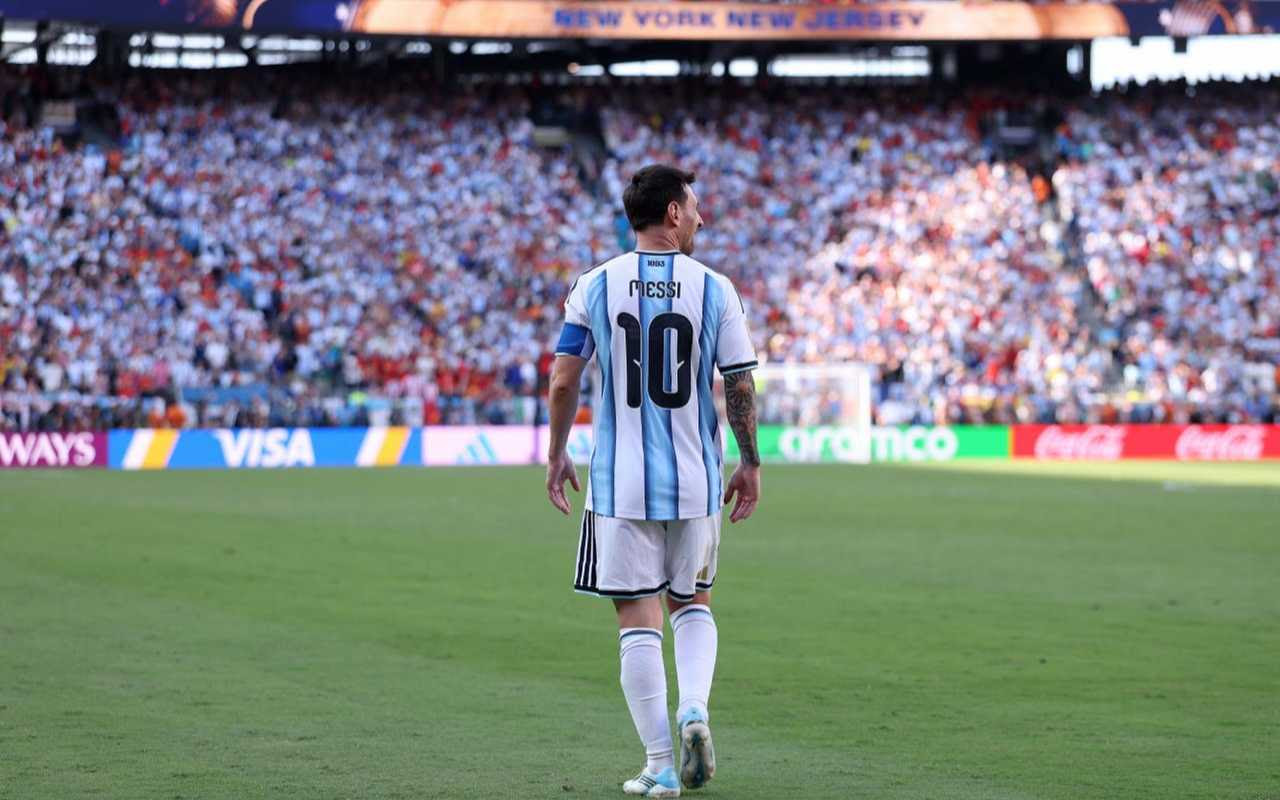
That is why the statement issued by the Argentine Federation of Sports Journalists (FAPED) is particularly significant. It praised and recognized the career of the Argentine captain. From Argentina’s organized sports journalism community, it is perfectly clear that Messi was not merely an extraordinary player: he was a historic figure who, for more than two decades, turned every match wearing the sky-blue and white shirt into a global event. And that recognition goes far beyond Argentina’s borders.
From AIPS America, the continental expression of the International Sports Press Association, we also wish to express our recognition of Lionel Messi for everything he has meant to sport and, particularly, to football in the Americas. Because when we talk about Messi, statistics help us measure his greatness, but they are not enough to explain everything he represents.
207 MATCHES FOR THE HISTORY BOOKS Throughout his 21 years wearing the Argentine shirt, Messi established records that place him at the top of the national team’s main historical statistics.
He played 207 matches, becoming the player with the most appearances in the history of the Albiceleste. He scored 125 goals, making him the national team’s all-time leading scorer. He recorded 68 assists, also making him Argentina’s all-time leader in that category.
And he played 34 matches in the final stages of the FIFA World Cup, an absolute record in the history of the tournament. But behind those numbers lies something much deeper.
FRUSTRATION, TEARS & PERSEVERANCE Messi lost the 2014 World Cup final against Germany and subsequently lost the 2015 and 2016 Copa América finals against Chile. Amid that frustration, he even announced his retirement from the national team in 2016.
It seemed that Messi’s story with Argentina could end there. But he returned. And he returned to prove that the greatest sporting stories are not always written on the first attempt.
HISTORICAL COMEBACK Under the guidance of Lionel Scaloni and alongside a new generation of players, Messi finally found the team he had been searching for all those years. The 2021 Copa América ended a 28-year drought without a major title for Argentina.
Then came the 2022 Finalissima and, finally, the moment that seemed destined to elude him throughout his career: winning the 2022 World Cup in Qatar. The story was completed with another continental title in 2024. Messi went from being the player criticized for losing finals to becoming the captain who lifted the most important trophies a footballer can win with his national team.
And perhaps that is the greatest lesson of his international career: He did not walk away when he lost. He came back. And the world of sports journalism chose him again.
OVER TWO DECADES Messi’s stature can also be measured from a different perspective: that of those who, for more than two decades, have had the responsibility of telling his story. At the 2026 World Cup, held in the United States, Canada and Mexico, the International Sports Press Association, AIPS, once again placed his name at the very top.
A total of 472 sports journalists from 121 countries took part in the vote to choose the best player of the World Cup, and Messi received 1,179 points, comfortably surpassing France’s Kylian Mbappé, who received 717, and England’s Jude Bellingham, with 470.
The election also had an important particularity: the vote took place before the World Cup final, meaning that the result was not influenced by the outcome of the decisive match. Messi finished his participation in the tournament with 8 goals and 4 assists in 7 matches.
The recognition carries special significance because it did not come from coaches, officials or former players. It was the result of the assessment of sports journalists from different continents, affiliated with AIPS, who participated in the selection process.
In other words, those who have followed, analyzed and covered football throughout his career chose to recognize him once again. And for AIPS America, that recognition carries an even greater meaning.
Because Messi has not only been a protagonist of Argentine football. His figure has crossed borders and generations. He has inspired millions of children, become a reference for footballers throughout the continent and, for sports journalists, been a constant source of stories, debates, emotions and historic events.
CONTINENTAL LEGACY That is why Messi’s farewell cannot be viewed solely as an Argentine matter. Messi belongs to Argentina, but his legacy also belongs to the Americas. Millions of Latin American children grew up watching him play. Thousands of journalists narrated his goals, his defeats, his titles and his greatest moments. Entire generations learned to see football differently because of his talent.
We told the story of the teenage Messi who arrived in the national team. The Messi who desperately searched for a title. The Messi who endured criticism. The Messi who came close to walking away. The Messi who returned. The Messi who became champion of America. The Messi who became world champion. And now, the Messi who understands that there is also a moment to say enough.
MORE THAN FOOTBALL Perhaps in a few years some of his records will be broken. Someone may play more matches. Another footballer may score more goals. A new talent may appear and play more games at a World Cup. But it will be much harder to replicate what Messi achieved around football. Because his legacy is not only about statistics. It lies in his ability to move several generations.
In taking Argentina’s name to every corner of the planet. In turning his left foot into a universal reference. And also in demonstrating that talent requires perseverance, especially when the results do not come. That is why the recognition from FAPED carries such enormous symbolic value. It is Argentine sports journalism saying thank you to one of its greatest protagonists.
And the recognition from AIPS, through the votes of sports journalists from 121 countries, confirms that this admiration goes beyond a flag, a shirt and a continent. From the Americas, the message must also be clear: Thank you, Lionel Messi. Thank you for the goals, the assists, the victories and also the defeats.
Thank you for the finals that were lost and for the titles that eventually arrived. Thank you for representing Argentina for 21 years, wearing the shirt of a national team that, with him as captain, ultimately became champions of America and of the world.
And above all, thank you for understanding that great legends are not built only by lifting trophies. They are also built by enduring when everything seems lost. Messi leaves the Argentine national team, but he does not leave football.
His shirt will change stages. His story, however, already belongs forever to the memory of world football. The Albiceleste will have a new chapter. But the Messi era is already history.

